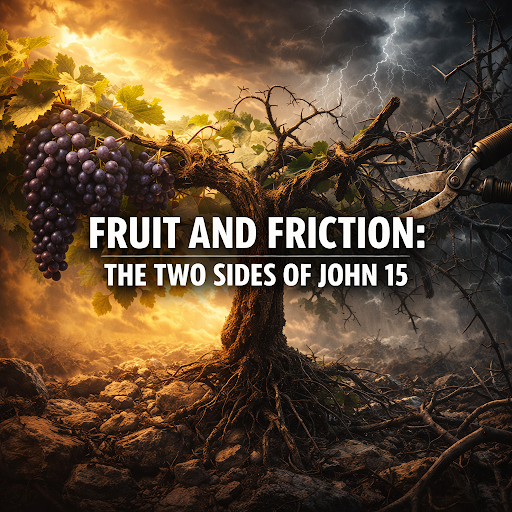
In business, everyone is big on results. If you are not producing, you will not survive. But in the Christian life, production looks different than it does inside in the world. Jesus calls it bearing fruit.
Most people love the first half of John 15. That is the section we put on coffee mugs and wall art. We like the idea of the vine and the branches, the calm pictures, the word “abide.” But if you keep reading past the fruit verses, the tone shifts.
In this one chapter, Jesus mentions “fruit” eight times and “hate” eight times. That is not an accident. He is showing us that internal growth always brings external opposition. You cannot have the fruit of the Spirit without the friction of the world.
The progression of fruit (John 15:2–16)
Jesus does not just want a little bit of growth. He wants a lifestyle of increasing fruit.
If you line up the eight mentions of fruit, there is a clear climb happening:
• No Fruit (v. 2a)
• Fruit (v. 2b)
• More fruit (v. 2c) – the result of God’s pruning
• Bearing Fruit (v. 4) – the reminder we cannot do it alone
• Much fruit (v. 5) – the peak of abiding
• Much fruit (v. 8) – the way we glorify the Father
• Bringing Fruit (v. 16a) – the reason He chose and ordained us
• Remaining fruit (v. 16b) – the kind that outlives us
The goal is to move from “fruit” to “much fruit” to “fruit that remains.”
In the business world I might call that optimization. In the Bible, it is just abiding. You do not squeeze out more fruit by trying harder in the flesh. You get more fruit by staying closer to the Vine.
And as the fruit increases, something else happens.
John 15:2 says the Father “purgeth” the branch that bears fruit, so it can bring forth more. That is pruning.
He cuts away the suckers that drain strength. He cuts away dead weight that looks harmless but slows things down. Pruning hurts. Sometimes it is a lost comfort, a closed door, a relationship you thought you needed. But without that cutting, you never reach the “much fruit” stage.
I have watched this in my own life. Seasons where God stripped things I thought I had to have, and at the time I did not like it at all. Later, looking back, I could see He was clearing space so something real could actually grow and I could produce more fruit for Him.
The pattern of hate (John 15:18–25)
Once the fruit shows up, the environment around the branch changes.
Jesus warns that as the inner life grows, the outer pressure rises. He uses the word “hate” eight times to match the eight fruits:
• Hate you (v. 18a) – the world’s default setting toward a believer
• Hated me (v. 18b) – Jesus took the first hit
• Hated you (v. 18c) – it started with Him, not you
• Hate because you are chosen (v. 19) – their reaction because you do not belong to them
• Hateth you (v. 23a) – they are not just upset with you
• Hateth the Father (v. 23b) – underneath it, they hate the Father
• Hated both (v. 24) – they reject the light they have seen
• Hated (v. 25) – hatred “without a cause,” totally unfair
Once again, Jesus is honest. He does not hide the cost.
You cannot preach much fruit and skip much hate. If the chapter ended at verse 17, we would all sign up. But He keeps talking.
No fruit, no hate
Here is the plain truth. If you have no fruit, you will have no hate.
A withered branch, dry and brown, does not bother anyone. It blends in with the dead wood on the ground. The world does not waste bullets on branches that look just like them.
If you cuss at the same stuff the lost guys do, laugh at the same filth, cheat the same way, they will receive you just fine. Jesus said, “the world loveth his own” (v. 19). You are not a problem for them.
But the moment you start bearing the fruit of honesty, kindness, purity, bold witness, you turn into a walking conviction. They may not know the verses, but they feel the conviction.
God hates it when Christians are fruitless, because the branch is wasting the power of the Vine. The world hates it when you are fruitful, because it proves the Vine is real.
They hated the Vine and the Husbandman first. When they see a branch that looks like the Vine, they respond the same way.
The trade off
You cannot pull these two eights apart.
If you want the “much fruit” of verse 5, you need to be ready for the “hateth you” of verse 19.
The world’s hatred is the “lot and portion” of a true disciple. It comes with the life. So when the friction starts, do not assume God left you.
It feels personal, but a lot of the time it is not about you. It is about the Vine. The pushback is often proof that fruit is finally there.
If the world has no problem with you, ever, you might not be as close to the Vine as you think. That is a hard sentence, but it is worth asking.
On the other hand, if you are abiding and the pressure is real, do not quit. Keep obeying. Keep staying close. The fruit is worth the friction.