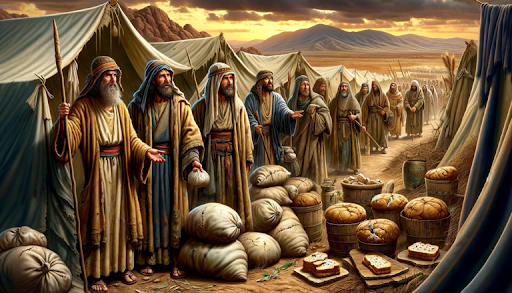
A lot of people hear the word standards and immediately think control, rules, or religion gone bad. They assume standards exist to limit freedom or steal joy. But when you look at how God arranged Israel’s camp, you see something very different. Biblical standards were always about order, protection, and nearness to God.
In Numbers 2, God did not tell Israel to spread out and find a spot that felt right. He gave exact instructions on who stood where, how far they stood, and which banner they stood under.
Numbers 2:2 says, “Every man of the children of Israel shall pitch by his own standard, with the ensign of their father’s house: far off about the tabernacle of the congregation shall they pitch.”
God organized the camp with intention. That same God still works with intention today in our lives.
Standards Are Built Around God’s Presence
The Tabernacle was the center of the camp. Everything revolved around where God dwelled. Distance and order mattered.
In the New Testament, God no longer dwells in a tent, He dwells in His people. Hebrews 12:29 reminds us our God is a consuming fire. Standards exist because God is near, not because He is distant. You do not set standards to get God’s attention. You set them because His presence deserves reverence.
Standards Show Who You Belong To
Each tribe camped under its own flag. Identity was visible and from a distance, you could tell who belonged where.
A believer’s standards quietly answer the same question. Who do you belong to. Not with loud words, but with consistent living.
Jesus said in Matthew 5:16, “Let your light so shine before men, that they may see your good works, and glorify your Father which is in heaven.”
Standards are not about drawing attention to yourself, but rather to point attention upward.
Standards Keep You Ready for Battle
Israel marched in the same order they camped. They did not scramble when the trumpet sounded because they were already arranged.
A Christian who lives without structure will panic under pressure. Spiritual battles are not fought with last minute decisions. They are fought with habits already in place.
Ephesians 6:11 tells us to put on the armor of God, not to look for it when the enemy shows up.
Standards Put Strength Where It Is Needed Most
The strongest tribes were placed on the outside of the camp so they would absorbed the first impact if someone was to attack.
Strong standards belong where temptation hits hardest. Weak areas require stronger guardrails, not looser ones.
Proverbs 4:23 says, “Keep thy heart with all diligence; for out of it are the issues of life.”
Ignoring weak spots is not faith, it is negligence.
The New Testament Reasoning Behind Standards
The picture is in Numbers and the explanation comes later in the New Testament.
Romans 13:14 tells us to make no provision for the flesh.
Hebrews 12:1 tells us to lay aside weights, not just sins.
2 Timothy 2:4 tells us a soldier limits himself to please the one who chose him.
Standards are not about how close you can get to the line, they are about staying effective in the fight.
Convictions are what you believe. Standards are what you build so those beliefs do not collapse under pressure.
Pharaoh hated standards because distance meant he was losing control. God established standards because distance from Egypt meant His people would survive.
Do not apologize for the fence. Thank God for it. It keeps His people positioned, protected, and ready.
⸻
HOW TO ESTABLISH BIBLICAL STANDARDS
1. Start With God’s Presence, Not Personal Preference
Standards do not begin with what you like or dislike. They begin with where God is placed in your life. Israel didn’t pitch their tents wherever it felt comfortable. They camped around the Tabernacle (Numbers 2:2). The question is not, Is this allowed, but Does this keep me close to the presence of God. Standards protect your proximity to God.
2. Settle Conviction Before You Build Boundaries
A standard without conviction will not last. It turns into tradition or pressure instead of obedience. Conviction is shaped by Scripture, prayer, and submission to God, not by culture or opinion. Romans 13:14 starts with putting on the Lord Jesus Christ before it talks about denying the flesh. What you believe has to be settled before you decide how you will live. Any standard built around other people’s convictions will eventually crumble. Settle what you believe from the Bible and build around that!
3. Put the Strongest Standards Where You Are Weakest
In the camp of Israel, the strongest tribes stood on the outside. That is where the danger was. Standards should be highest where temptation hits hardest. Proverbs 4:23 does not say to casually watch your heart. It says to guard it with diligence. Do not start by building fences around areas you already handle well. Start by building around the areas where you know you are vulnerable to falling or obeying God.
4. Remove Access, Not Just Intentions
The Bible does not say to fight the flesh with willpower alone. It says to make no provision for it (Romans 13:14). Standards are practical. If something feeds temptation, it should not stay within reach. Good intentions without distance always fail under pressure.
5. Match Your Standards to Your Calling
A soldier limits his freedom so he can please the one who chose him (2 Timothy 2:4). Standards are not about control, they are about readiness. Ask a simple question, Does this help me obey God faster and serve Him better? If it slows you down, distracts you, or entangles you, it is a weight, even if it is not an obvious sin (Hebrews 12:1).
6. Listen to Someone Who Has Walked This Road Before You
God never designed standards to be formed in isolation. In the camp of Israel, no man decided his position alone. Wisdom is often found in those who have already fought the battles you are just entering. Proverbs 11:14 says there is safety in a multitude of counsellors. A godly pastor, a faithful parent, an older saint, or a seasoned believer can see dangers you cannot yet see. Asking for counsel is not weakness, it is humility. Pride builds standards alone. Wisdom builds them with help.
7. Apply Grace Without Lowering the Standard
Standards are meant to protect people, not crush them. Israel’s camp had order, but it also had provision, patience, and mercy built into it. A standard without grace turns into pride. Grace without standards turns into compromise. When someone stumbles, the answer is not to tear down the fence, it is to help them stand back up inside it. Galatians 6:1 reminds us to restore with meekness, not superiority. If your standards make you harsh, you missed the heart of God. If your grace removes boundaries, you missed the holiness of God. Both matter.