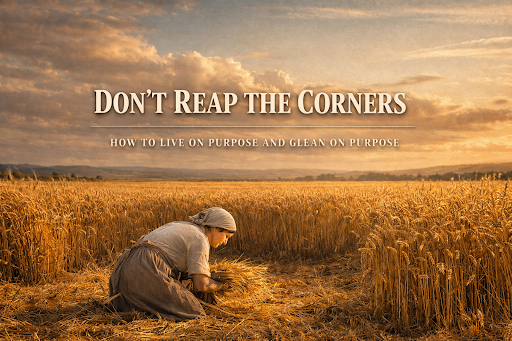
God told Israel to leave the corners of their fields. He wasn’t against them making a profit; He was against them harboring a heart of selfishness. He built generosity into their farming, humility into their survival, and mercy into the very system of their society.
Leviticus 19:9–10, “And when ye reap the harvest of your land, thou shalt not wholly reap the corners of thy field, neither shalt thou gather the gleanings of thy harvest. And thou shalt not glean thy vineyard, neither shalt thou gather every grape of thy vineyard; thou shalt leave them for the poor and stranger: I am the LORD your God.”
We are not farmers today, but we still reap. We reap income, influence, knowledge, and time. The problem is that most of us harvest right to the very edges. Here is how we apply the law of gleaning to our modern lives.
1. LEAVE CORNERS IN YOUR LIFE
Leviticus 19 was a command to create margin. The farmer could not scrape every inch of his property for his own gain; he had to leave something behind for someone else. This is a direct hit on how most Christians live today.
Most people run at 100 percent capacity. Every dollar is assigned, every hour is booked, and every weekend is consumed. There are no “corners” left. If there is no margin in your schedule or your bank account, no one can glean from you.
How this looks today:
- Finances: Do not spend every dime of a raise. Leave room to give.
- Time: Do not fill every night with personal hobbies. Leave space to serve.
- Availability: Do not structure life so tightly that a sudden need feels like an annoying interruption.
2. GLEANING REQUIRES HUMILITY
In the book of Ruth, we see a wealthy landowner and a poor widow. Ruth did not demand a handout; she asked for permission. She worked behind the reapers, bending low to pick up leftovers. Gleaning is “low to the ground” work.
Many Christians struggle today because they refuse to glean. They want a full field handed to them without the effort. Gleaning today looks like learning quietly from those ahead of you, taking small opportunities instead of waiting for “the big one,” and doing work that others might think is beneath them. Ruth did not own the field, but she owned her effort. There is dignity in that.
3. GOD OVERSEES THE FIELD
Ruth 2:3, “And she went, and came, and gleaned in the field after the reapers: and her hap was to light on a part of the field belonging unto Boaz, who was of the kindred of Elimelech.”
It looked like a random coincidence, but it was the providence of God. Boaz knew the law of Leviticus 19 and he went even further—he told his men to let fall “handfuls on purpose” for her.
God often hides handfuls in fields you didn’t plan to visit. You don’t control the field, and you don’t control the landowner. You only control your faithfulness within it. Show up, work hard, and trust God to direct your steps to the right portion of the field.
4. JESUS DEFENDED GLEANING
In Matthew 12, the disciples were hungry, so they plucked ears of corn as they walked through a field. The Pharisees, who watched the field but never bent down to feed anyone, accused them of breaking the Sabbath. Jesus sided with the hungry.
Two lessons surface here:
- It is not wrong to receive: Some believers feel guilty accepting help. God built provision into His law for a reason. Pride is what rejects what God allows.
- Critics will always watch: There are people who know every rule in the book but don’t know a thing about mercy. Never let a religious critic stop you from receiving what God has provided.
5. GLEAN FROM THE WORD AND FROM SEASONS
Gleaning isn’t just physical; it’s spiritual. When you read your Bible, you are gleaning. You may not understand every complex chapter today, and that’s fine. Pick up what you can carry. One verse, one truth, or one correction is enough to sustain you.
Furthermore, you must glean from your hard seasons. When you are in a “Ruth” season—exposed and following behind others—glean anyway.
- Glean patience from the waiting.
- Glean strength from the pressure.
- Glean wisdom from the failure.
6. BECOME A FIELD OTHERS CAN GLEAN FROM
At some point, Ruth stopped being the one in the corners and became part of the lineage of the King. The Christian life matures this way: first you glean, then you leave corners.
As you grow, start mentoring someone younger in the faith. Share your resources without being asked. Open doors that were once closed to you for someone else. You once survived on gleaned grace; now, leave something behind for the next person.
CLOSING THOUGHT
“I am the LORD your God.” That is how the command in Leviticus ends. Gleaning isn’t really about agriculture; it’s about recognizing who owns the field. You don’t own your increase, you don’t control your placement, and you don’t decide who deserves mercy. God does.
So, leave your corners. Bend low when needed. Work faithfully in whatever field you find yourself in today, and trust the Lord of the harvest to handle the rest.