Who Got Saved in the Old Testament
A harlot in Jericho and a Syrian general and a Sidonian widow do not look like they have much in common. They lived in different countries, in different centuries, with different gods and different languages.
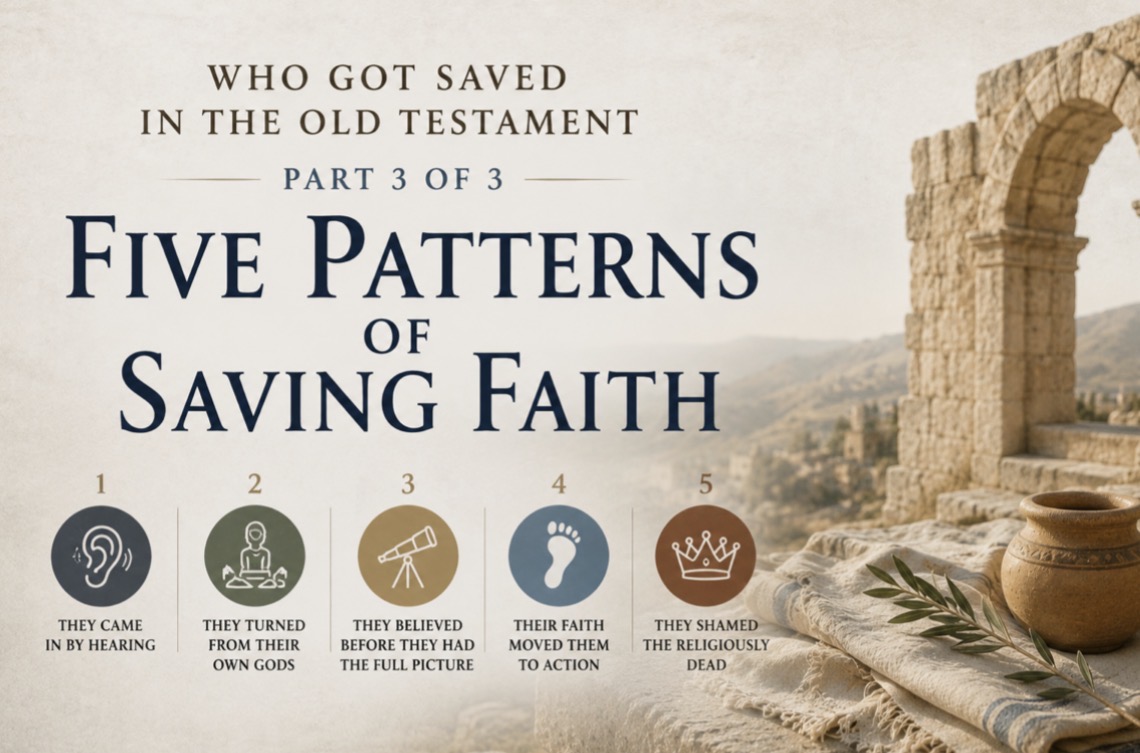
But when you line up the ten Gentiles from Part 2 side by side and study how they came to the God of Israel, the same six marks show up in every one of them. Five patterns of saving faith. The same five marks that show up in a New Testament Christian today.
1. They Came in by Hearing
Every one of them came to God because they heard something about Him. Rahab heard about the Red Sea and the Amorites. Ruth heard from Naomi. Naaman heard from a little servant girl in his wife’s kitchen. The widow of Zarephath heard from Elijah. Nineveh heard from Jonah. None of them were born into Israel. None of them stumbled in by accident. They got in by ear.
Romans 10:17, “So then faith cometh by hearing, and hearing by the word of God.”
Somebody opens their mouth, somebody else opens his ear, and the Holy Ghost works in the heart.
That is why the gospel has to be preached. That is why a parent has to talk to their children. That is why the Christian has to open their mouth at work, in their neighborhood, and in their family. Nobody is saved without hearing.
2. They Turned From Their Own Gods
Every one of them broke clean with what they used to worship. Ruth left Chemosh. Naaman swore he would never offer sacrifice to another god again. Rahab walked away from the gods of Jericho. The widow of Zarephath came out of Baal country. Nineveh tore down their idols.
Salvation is a turning in your heart from whatever you were trusting in before. The man who wants to keep his old gods and add Jesus to the shelf has never really been converted.
1 Thessalonians 1:9, “And how ye turned to God from idols to serve the living and true God.”
Paul says it as one motion. Turned to God from idols. You cannot turn to Him without turning from them. Today, a man may not have a wooden statue in his house, but he has idols. Money, status, the body, the family, or the career. Real conversion turns away from trusting all of them and toward Jesus!
3. They Believed Before They Had the Full Picture
None of these nine had the New Testament. None of them had a clear picture of who Jesus would be. They believed in the Promised Seed, the Redeemer, the Lamb pictured in the sacrifice, or the God who would one day make it right. They trusted what they had and they trusted Him for the rest.
Hebrews 11:13, “These all died in faith, not having received the promises, but having seen them afar off, and were persuaded of them, and embraced them, and confessed that they were strangers and pilgrims on the earth.”
They saw it afar off and believed it anyway. This is called faith and God has always honored it.
He does not require a man to know everything. He requires him to trust what He has revealed.
Nobody comes to God with a complete understanding of the whole Bible. Nobody has to. He just has to come, and the Lord meets him at the door.
4. Their Faith Moved Them to Action
Not one of them just believed and went home. Rahab hid the spies. Ruth left her country. Jethro built an altar. Naaman dipped seven times. The widow gave up her last meal. Ebedmelech pulled Jeremiah out of the pit at the risk of his own life. Nineveh fasted in sackcloth from the king down to the cattle.
Real faith moves to action. Actions don’t save us. But real faith has works behind it. The faith that says, “I believe,” and then keeps living the same way, is not the faith that saved Rahab.
James 2:17, “Even so faith, if it hath not works, is dead, being alone.”
James 2:25, “Likewise also was not Rahab the harlot justified by works, when she had received the messengers, and had sent them out another way?”
James points back to Rahab by name. She is one of his two examples of saving faith, right next to Abraham. The Gentile harlot is held up next to the father of Israel because they both had a faith that moved to action.
5. They Shamed the Religiously Dead
Rahab feared God when most of Israel did not. Ruth was more godly than Naomi for half her book. Naaman went home to worship the LORD while Israel under Joram was bowing to calves. Nineveh repented at one sermon while Israel had rejected hundreds of prophets up the road.
Over and over, the Gentile outsiders shamed the Israelite religion.
Matthew 8:11-12, “And I say unto you, That many shall come from the east and west, and shall sit down with Abraham, and Isaac, and Jacob, in the kingdom of heaven. But the children of the kingdom shall be cast out into outer darkness: there shall be weeping and gnashing of teeth.”
Romans 9:30-32, “What shall we say then? That the Gentiles, which followed not after righteousness, have attained to righteousness, even the righteousness which is of faith. But Israel, which followed after the law of righteousness, hath not attained to the law of righteousness. Wherefore? Because they sought it not by faith, but as it were by the works of the law.”
Being close to the truth is not the same as believing the truth. Sitting in church is not the same as trusting in Christ. Having a Bible in the house is not the same as having a Bible in the heart. The Gentile outsiders heard a fraction of what Israel had and ran to God with what they had. The Israelites had everything and stayed home.
There will be many a church member with a Bible on his nightstand and praise on his lips who will wake up one day and hear the Lord say, “Depart from me, I never knew you.” Religious activities can’t save us. Only the death, burial and resurrection of Jesus Christ.
Acts 10:34-35, “Of a truth I perceive that God is no respecter of persons: But in every nation he that feareth him, and worketh righteousness, is accepted with him.”
The door God opened to Melchizedek and Rahab and Ruth and Naaman is the same door He has opened to every man, woman, and child who will come. Same blood, name and Saviour. The only question is whether you are walking through that door the same way they did, or whether you are sitting close to it, like some of the Israelites of the Old Testament, and never going through.