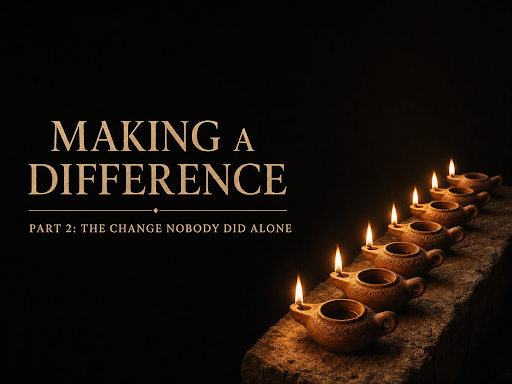
In Part 1 we looked at Josiah’s heart. One young king who decided to seek God when nobody else was. His personal decision started the whole transformation of Judah. But if you read 2 Chronicles 34 carefully, you notice something.
Josiah did not do it alone.
* The chapter names fifteen different kinds of servants who played a role.
* Scribes and priests.
* Musicians and stone workers.
* Governors and gatekeepers.
* A prophetess and a whole delegation sent to hear from her.
* Elders and ordinary people.
* Every one of them had a specific job.
1. Real Change Takes Many Hands
Here is the full roster of who did what in 2 Chronicles 34.
* Josiah, the king who led
* Shaphan, the scribe who administered the temple repair and read the Word to the king
* Maaseiah, the governor of the city
* Joah, the recorder who documented everything
* Hilkiah, the high priest who found the book of the law
* Jahath and Obadiah, Levite overseers from the sons of Merari
* Zechariah and Meshullam, Levite overseers from the Kohathites
* The Levite musicians who kept worship going during the work
* The Levite officers, porters, and scribes who ran the daily operations
* The carpenters, builders, and artificers who did the hands-on construction
* Huldah the prophetess who spoke for God
* The delegation of five men sent to Huldah for a word
* The elders of Judah and Jerusalem
* The priests
* All the people, great and small, who stood under the covenant
Christians have a bad habit of thinking real ministry only happens through pastors and paid staff. Scripture disagrees. Every reformation in the Bible required many kinds of servants working together, and 2 Chronicles 34 is the roadmap for what that looks like.
A church that only has one person doing all the work is not built to make a change. One persons heart can start, but it’s going to take a lot of help to get the work done.
2. Different Gifts, Same Mission
Look at how different these jobs were.
* Some of the workers were skilled craftsmen cutting stone.
* Some were musicians playing instruments.
* Some were scribes managing paperwork.
* Some were priests handling sacred duties.
* Some were porters guarding gates.
* Some were prophets speaking words from God.
* Some were officials keeping records.
* Some were ordinary people standing under the reading of the covenant.
They did not all have the same gifts. But every one of them was working for the same God.
1 Corinthians 12:14-18 “For the body is not one member, but many. If the foot shall say, Because I am not the hand, I am not of the body; is it therefore not of the body? And if the ear shall say, Because I am not the eye, I am not of the body; is it therefore not of the body? If the whole body were an eye, where were the hearing? If the whole were hearing, where were the smelling? But now hath God set the members in the body, as it hath pleased him.”
Paul says the same thing about the church that 2 Chronicles 34 pictures in the temple restoration. Every member and gift matters. God set each member exactly where He wanted them.
Your gift and role matters. Your section of the work matters. Do not spend your life wishing you had somebody else’s job when God has already assigned you the one He wants you to do!
3. Worship Continued During the Work
Here is one of the sweetest details in the whole chapter.
2 Chronicles 34:12 “And the men did the work faithfully: and the overseers of them were Jahath and Obadiah, the Levites, of the sons of Merari; and Zechariah and Meshullam, of the sons of the Kohathites, to set it forward; and other of the Levites, all that could skill of instruments of musick.”
While the workers were repairing the temple, the Levite musicians were playing.
They did not say, “We will worship when the building is ready.” They played their instruments in the middle of the construction. Worship happened in the mess.
Christians who wait for everything to be fixed before they worship are going to wait a long time. Life is always in some kind of construction. There is always something broken, some season of repair, some area of the house that is torn apart. If we wait for the perfect moment to worship, we will never worship.
If you are living in the middle of a mess right now, the biblical response is not to stop worshiping. It is to keep the music going while God does the repair.
Worship in the wreckage.
4. Faithful Ordinary Work Matters
“And the men did the work faithfully.”
God stopped and recorded that the ordinary workers, the carpenters and stone cutters and laborers, did their work faithfully.
Colossians 3:23-24 “And whatsoever ye do, do it heartily, as to the Lord, and not unto men; Knowing that of the Lord ye shall receive the reward of the inheritance: for ye serve the Lord Christ.”
Faithful ordinary work is holy work. The Christian who shows up every day and does his job well, is doing something that matters to God.
Most of us will never have a Josiah moment. We will never lead a nationwide to turn back to God. We will never be named in a chapter of the Bible. But we can be the men and women who do the work faithfully and God will always notice.
The stone worker in 2 Chronicles 34 did not get his name in the Bible, but his faithfulness did.
Nehemiah 3 tells the story of how the walls of Jerusalem were rebuilt after the exile. Reading it carefully, you see the same pattern as 2 Chronicles 34. Every family, every craftsman, every priest, every merchant repaired a specific section of the wall. Some worked on the sheep gate, and some on the fish gate. Some worked next to their own houses. Some worked on the towers. All different sections, but one wall.
That is a picture of the body of Christ. God has given each of us a section of the wall.
That is still how God does it. Find your section and trust that God is building something bigger than you can see with the hands of everyone who is doing the same.