Every Christian at some point asks the same question. What is God’s vision for my life? Where does He want me to go? What does He want me to do?
How do we get God’s vision for our life? The Bible gives us a full picture of a man who received God’s vision more clearly than almost anyone else in Scripture, and it walks us through exactly how it happened. His name was Abraham, and Genesis 12 through 15 gives us the pattern.
Genesis 15:1 “After these things the word of the LORD came unto Abram in a vision, saying, Fear not, Abram: I am thy shield, and thy exceeding great reward.”
God became Abram’s shield, which is his protection, and his exceeding great reward, which is his blessing. But notice the phrase at the top of the verse. “After these things.” God did not give the vision on day one. He gave it after Abram walked through three specific things first.
1. Abraham Got God’s Vision When He Separated
Before God ever gave Abram the full vision of the land, God asked him to separate.
Genesis 12:1-3 “Now the LORD had said unto Abram, Get thee out of thy country, and from thy kindred, and from thy father’s house, unto a land that I will shew thee: And I will make of thee a great nation, and I will bless thee, and make thy name great; and thou shalt be a blessing: And I will bless all the families of the earth.”
Three separations in one command. Get out of your country, get out from your kindred and get out of your father’s house. God was asking Abram to walk away from everything familiar so he could walk into everything God had promised.
Lot Came With Him
Genesis 12:4 “So Abram departed, as the LORD had spoken unto him; and Lot went with him: and Abram was seventy and five years old when he departed out of Haran.”
Genesis 13:1 “And Abram went up out of Egypt, he, and his wife, and all that he had, and Lot with him, into the south.”
Genesis 13:5-7 “And Lot also, which went with Abram, had flocks, and herds, and tents. And the land was not able to bear them, that they might dwell together: for their substance was great, so that they could not dwell together. And there was a strife between the herdmen of Abram’s cattle and the herdmen of Lot’s cattle…”
Abram obeyed most of the command. He left his country, left Haran, but Lot came with him. And Lot was part of his father’s house.
Abram had done the outward separation, but there was still a piece of the old life traveling in his tent. Strife eventually broke out, because the land could not hold both of them and their herds together. Partial obedience always eventually causes strife.
The Separation
Genesis 13:9 “Is not the whole land before thee? separate thyself, I pray thee, from me: if thou wilt take the left hand, then I will go to the right; or if thou depart to the right hand, then I will go to the left.”
Genesis 13:11 “Then Lot chose him all the plain of Jordan; and Lot journeyed east: and Abram and Lot separated themselves the one from the other.”
Abram finally said the word: Separate. He offered Lot the whole land and let him pick. Lot chose the plain toward Sodom and Abram let him go.
Abram loved Lot and he still helped him later in chapter 14 when four kings took Lot captive, and Abram armed his men and rescued him.
Separation did not mean hate. It meant Abram was no longer going to let a partial family attachment slow down what God had called him to do.
The Vision Came After the Separation
Genesis 13:14-15 “And the LORD said unto Abram, after that Lot was separated from him, Lift up now thine eyes, and look from the place where thou art northward, and southward, and eastward, and westward: For all the land which thou seest, to thee will I give it, and to thy seed for ever.”
“After that Lot was separated from him, Lift up now thine eyes.” God waited, and did not give Abram the full vision of the land while Lot was still in the tent. He gave it after the separation was complete.
The pattern is impossible to miss. God does not give the full vision to a divided heart.
For us today, every Christian who wants God’s vision for their life has to be willing to ask an honest question. What is still traveling in my tent that God told me to leave behind? What partial attachment is causing strife between what I say I want and what I actually do?
2. Abraham Got God’s Vision When He Became a Steward
The second thing Abram walked through was learning to open his hands with what God had given him. Genesis 14 is a chapter about two kinds of giving, and both of them had to happen before the vision of chapter 15 came.
Tithes of All
Genesis 14:18-20 “And Melchizedek king of Salem brought forth bread and wine: and he was the priest of the most high God. And he blessed him, and said, Blessed be Abram of the most high God, possessor of heaven and earth: And blessed be the most high God, which hath delivered thine enemies into thy hand. And he gave him tithes of all.”
Abram had just won a huge battle. He rescued Lot, defeated four kings, and came back with all the spoils. Then Melchizedek showed up, priest of the most high God, and blessed him. And Abram gave him tithes of all.
What we give is a picture of who we trust. Abram was saying, God is my possessor. This land, my possession and this victory belong to Him first. I am not the owner. I am simply the steward.
I Will Not Take
Genesis 14:21-23 “And the king of Sodom said unto Abram, Give me the persons, and take the goods to thyself. And Abram said to the king of Sodom, I have lift up mine hand unto the LORD, the most high God, the possessor of heaven and earth, That I will not take from a thread even to a shoelatchet, and that I will not take any thing that is thine, lest thou shouldest say, I have made Abram rich.”
Right after the tithe, the king of Sodom offered Abram all the goods. And Abram said no. Not a thread, a shoelatchet or smallest strand of leather from a sandal. He refused to let the king of Sodom pay him.
There are two pieces to Bible stewardship.
What we give is one side of the coin. Who we take from is the other. Abram gave freely to God, and he refused freely from the world. Both actions came from the same heart. He knew who he belonged to, and he was not going to let a pagan king put his fingerprints on Abram’s future.
The Vision Came After the Giving
Genesis 15:1 “After these things the word of the LORD came unto Abram in a vision…”
Genesis 14 ends with Abram tithing and refusing. Genesis 15 opens with God appearing in a vision saying, “I am thy shield, and thy exceeding great reward.”
Abram refused Sodom’s reward, and God Himself became his exceeding great reward.
When we refuse the world’s payment, God Himself becomes our reward. A Christian who is closed-handed with God and open-handed with the world will rarely see God’s fuller vision, because their hands are full of the wrong things.
For us today, stewardship is not a business word. It is a Bible word, and it comes before the vision.
3. Abraham Got God’s Vision When He Sacrificed
The third and deepest step was sacrifice.
Believing With Questions
Genesis 15:6 “And he believed in the LORD; and he counted it to him for righteousness.”
Genesis 15:8 “And he said, Lord GOD, whereby shall I know that I shall inherit it?”
First Abram believed. That belief was counted to him for righteousness. Paul quotes this verse in Romans 4 and Galatians 3 as the foundation of the whole doctrine of justification by faith. But then, two verses later, Abram asks God a question. “Whereby shall I know?”
This kind of question is not doubt but a request for confirmation, the same kind of asking Mary made in Luke 1 when she said “How shall this be?” God did not rebuke Abram for asking. He answered with a covenant ceremony. Sacrifice starts with a heart that believes God even when the whole thing is bigger than we can understand.
The Aisle and the Altar
Genesis 15:9-10 “And he said unto him, Take me an heifer of three years old, and a she goat of three years old, and a ram of three years old, and a turtledove, and a young pigeon. And he took unto him all these, and divided them in the midst, and laid each piece one against another: but the birds he divided not.”
God told Abram to bring five animals and cut them in two, laying them out in two rows with a path down the middle. In the ancient world, this was how a covenant was made. Both parties would walk between the pieces to seal the promise, essentially saying “may I be cut in pieces like these animals if I break this covenant.”
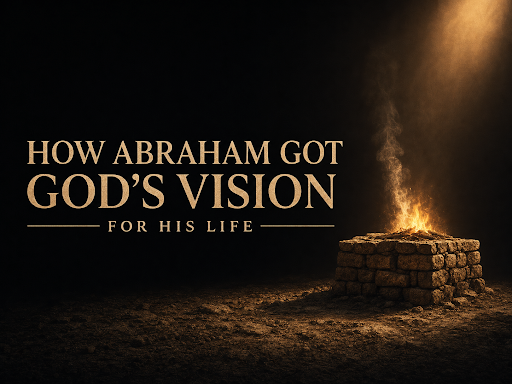
The path between the pieces was the aisle. The pieces themselves were the altar.
Then something amazing happens.
Genesis 15:17 “And it came to pass, that, when the sun went down, and it was dark, behold a smoking furnace, and a burning lamp that passed between those pieces.”
God walked the aisle alone when Abram was in a deep sleep. He could not walk the aisle or seal his half of the covenant. God, appearing as a smoking furnace and a burning lamp, passed between the pieces by Himself.
That is the picture of the gospel in the Old Testament. God cut a covenant that Abram could not cut. Christ Himself would later walk the ultimate aisle of the cross alone, laying down His life on the altar for us while we were still sleeping in our sin (Romans 5:8).
The Sacrifice Must Be Protected
Genesis 15:11 “And when the fowls came down upon the carcases, Abram drove them away.”
While the sacrifice lay there, birds of prey came down to steal it. Abram had to drive them off. He was not walking the aisle yet or receiving the vision yet. He was guarding what he had already laid down.
These birds picture the enemies of the covenant, the distractions and attacks and temptations that come to steal what God is doing in our lives. Abram had to defend the altar while he waited for God to finish the covenant. He could not let the sacrifice get carried off before God passed through.
For us today, the sacrifice always gets attacked.
Old temptations circling, old voices calling and old comforts asking to come back. Our job is to drive off. Faith is not just laying it down once. Faith is guarding what we have laid down until God finishes the covenant.
Abraham got God’s vision for his life the same way we get God’s vision for ours. He separated from what did not belong. He stewarded what God had given by giving to God and refusing from the world. He sacrificed by believing with questions, laying the pieces on the altar, and driving the birds away until God finished the covenant.
Abraham made mistakes along the way. He went to Egypt, lied about Sarah, and he listened to Sarah about Hagar. But he still received God’s vision for his life.
Separate what does not belong. Steward what God has given. Sacrifice what He asks for. Then lift up your eyes and look because God will provide you the vision you need for tomorrow.