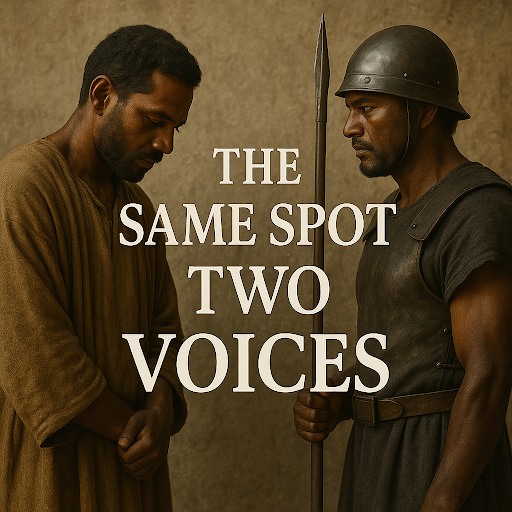
There’s a spot in the Bible where two men stand about 30 years apart, saying two very different things. One speaks for God. The other speaks against Him. Same place. Same pressure. But a very different outcome.
That place is called “the conduit of the upper pool in the highway of the fuller’s field.” You’ll find it in Isaiah 7:3 and again in Isaiah 36:2. It’s easy for us to read past it. But if we slow down, there’s a lesson there worth preaching.
Let me show you the four comparisons between these two chapters.
1. Two Men Were Sent There
In Isaiah 7:3, the Bible says: “Then said the Lord unto Isaiah, Go forth now to meet Ahaz, thou, and Shearjashub thy son, at the end of the conduit of the upper pool in the highway of the fuller’s field.”
God sent His prophet to speak to King Ahaz. Why? Because enemies were gathering, and Ahaz was scared. God’s message was clear: “Fear not, neither be fainthearted” (Isaiah 7:4).
But in Isaiah 36:2, something different happens: “And the king of Assyria sent Rabshakeh from Lachish to Jerusalem unto king Hezekiah with a great army. And he stood by the conduit of the upper pool in the highway of the fuller’s field.”
This time it’s not a prophet, it’s an enemy soldier. Not sent by God, but by the king of Assyria. His job was to scare Hezekiah into giving up.
One man was sent to build faith. The other to tear it down.
2. Two Messages Were Preached
When Isaiah spoke to Ahaz, he said:
“If ye will not believe, surely ye shall not be established” (Isaiah 7:9).
That was a warning. But it was also an offer. God was giving Ahaz a chance to trust Him. He even told him to ask for a sign (Isaiah 7:11). But Ahaz wouldn’t do it. He didn’t want to hear from God.
When Rabshakeh showed up in chapter 36, he had another message:
“What confidence is this wherein thou trustest?” (Isaiah 36:4)
And again in verse 7: “But if thou say to me, We trust in the Lord our God: is it not he, whose high places and whose altars Hezekiah hath taken away…?”
He mocked their faith. He didn’t understand it. And he tried to tear it down.
God’s man said, “Trust God.” The enemy said, “God can’t help you.”
3. Two Kings Made a Choice
Ahaz, in chapter 7, heard God’s word and still chose to lean on man. He made a deal with Assyria. He sent gold and silver from the temple to try and buy safety (2 Kings 16:7-8). And worse, he brought in idols (2 Kings 16:10-12).
He didn’t want God’s help. He wanted control. His choice brought ruin later.
But Hezekiah made a different choice.
“And it came to pass, when king Hezekiah heard it, that he rent his clothes, and covered himself with sackcloth, and went into the house of the Lord” (Isaiah 37:1).
Then he sent for Isaiah. He prayed. He humbled himself. He laid it all before the Lord.
One king trusted himself and fell. The other trusted God and stood.
4. Two Results Came Out of It
After Ahaz rejected God’s help, the Lord said: “The LORD shall bring upon thee… the king of Assyria” (Isaiah 7:17).
That’s the same nation he had trusted. The thing he leaned on ended up being the thing that crushed him.
But in Hezekiah’s case, God stepped in and defended him.
“Then the angel of the LORD went forth, and smote in the camp of the Assyrians a hundred and fourscore and five thousand” (Isaiah 37:36).
One prayer brought victory. One alliance brought judgment.
Ahaz lost everything. Hezekiah saw a miracle.
Two men stood in the same spot years apart. One gave God’s message. One gave Satan’s message. One king trusted man. The other trusted God.
The lesson is simple: when pressure comes, you don’t need a new place. You just need the right voice. And you better be careful who you listen to.
Your next victory might just come from standing where someone else once failed, but choosing to believe instead of fear.