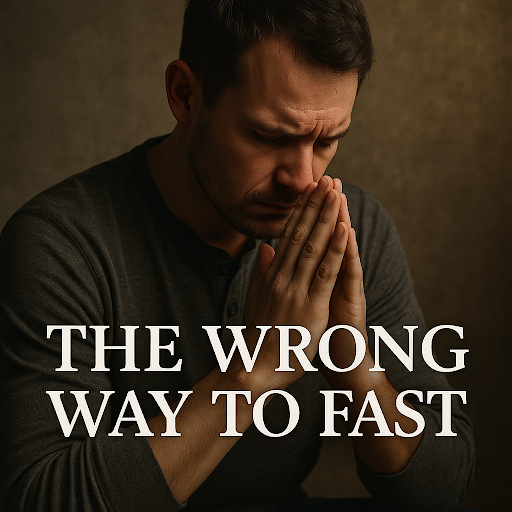
In Isaiah 58, God confronted His people about their fasting. They were skipping meals, bowing their heads, and wearing sackcloth, but their hearts were wrong. They asked in verse 3, “Wherefore have we fasted, say they, and thou seest not? wherefore have we afflicted our soul, and thou takest no knowledge?”
God’s answer cut through their ritual. He said, “Behold, in the day of your fast ye find pleasure, and exact all your labours. Behold, ye fast for strife and debate, and to smite with the fist of wickedness” (Isaiah 58:3–4). They were using their fast as a show of religion while still fighting, arguing, and oppressing others.
Jesus spoke of the same problem in the New Testament. In Matthew 6:16 He said, “Moreover when ye fast, be not, as the hypocrites, of a sad countenance: for they disfigure their faces, that they may appear unto men to fast.” Some were fasting for attention, hoping men would see their “sacrifice.”
The wrong way to fast is to turn it into a display or to use it as leverage, like we are forcing God to act because we went without food. That kind of fasting is empty.
The Right Way to Fast
The Bible doesn’t just tell us what fasting should not be, it tells us how to do it rightly.
First, Jesus made it clear that fasting is expected of His followers. In Matthew 6:16–18 He didn’t say if you fast, He said “when ye fast.” He taught us to fast quietly, to wash our face, and to keep it between us and God. “But thou, when thou fastest, anoint thine head, and wash thy face; That thou appear not unto men to fast, but unto thy Father which is in secret: and thy Father, which seeth in secret, shall reward thee openly” (Matthew 6:17–18).
The Bible gives us liberty in many of the details, but it gives us clear principles to follow:
- When to fast: Some fasted during times of crisis (2 Samuel 12:16), others when seeking God’s will (Acts 13:2–3). The church in Antioch fasted when sending out missionaries. There is no commanded day or length, but it should be done as the Lord leads.
- Where to fast: Jesus warned not to fast to be seen. This means fasting is best kept private. It can happen in your home, or even while going about daily life, but it is meant to be between you and God.
- How to fast: Fasting always goes with prayer. In Matthew 17:21, when the disciples could not cast out a demon, Jesus told them, “Howbeit this kind goeth not out but by prayer and fasting.” Fasting without prayer is just dieting. Prayer gives fasting its purpose.
- What kind of fast: The Bible shows different kinds. Daniel fasted from certain foods (Daniel 10:3). Jesus went forty days with nothing (Matthew 4:2). Paul spoke of “fastings often”, sometimes for religious purposes and other times because of financial. (2 Corinthians 11:27). God allows liberty, but the heart must be humble.
Fasting is not about punishing the body for the sake of it. It is about putting aside what feeds the flesh so we can seek the Lord in prayer.
What Fasting Should Lead To
Isaiah 58:6–7 shows the outcome God wants from a fast that pleases Him:
“Is not this the fast that I have chosen? to loose the bands of wickedness, to undo the heavy burdens, and to let the oppressed go free, and that ye break every yoke? Is it not to deal thy bread to the hungry, and that thou bring the poor that are cast out to thy house? when thou seest the naked, that thou cover him; and that thou hide not thyself from thine own flesh?”
True fasting should lead to real change. It should break sin’s grip in our lives, soften our hearts toward those in need, and open our eyes to burdens we can lift from others. It should lead us to action: feeding the hungry, clothing the naked, and helping the hurting.
Fasting is not about earning points with God. It is about humbling ourselves, tying prayer and self-denial together, and letting God use that time to do His work in us and through us.
Isaiah’s rebuke still speaks today: Don’t fast for show. Don’t fast to get your way. Fast to get closer to Him, and let that closeness pour out in compassion and service to others.