It is not hard to look around right now and feel like we are watching Romans 1 play out in real time.
You see people confused about who they are, lawlessness masked as protest, homes falling apart, sin being paraded as if it is something to be proud of, and the Bible mocked.
Romans 1 says three times that God “gave them up” when they changed His truth into a lie. When a culture starts calling evil good and good evil, judgment will come. You are watching God lift His hand and letting people choke on their own sin.
But even in the middle of judgment, believers are not left without hope.
Elijah knew what that felt like. He lived under Ahab and Jezebel. Baal’s altars were everywhere and God’s prophets were hiding in caves or already dead. It was dark, yet God was not missing. In Elijah’s hardest days, God was actually the most real to him.
1 Kings 17:1, “And Elijah the Tishbite, who was of the inhabitants of Gilead, said unto Ahab,
As the LORD God of Israel liveth, before whom I stand, there shall not be dew nor rain these years, but according to my word.”
Judgment was coming, but Elijah knew where he stood. “Before whom I stand.”
So how do you find God when the world around you is falling apart under God’s judgment?
Let’s walk through what God did with Elijah.
1. Isolation Helps Us Find God in the Judgment
Right after Elijah announces the drought judgment, God does something that sounds strange.
1 Kings 17:3, “Get thee hence, and turn thee eastward, and hide thyself by the brook Cherith…”
“Hide thyself” or go get cut off.
Cherith means “to cut off” or “to separate.” God used a national judgment to pull His man out of the flow and into a hidden place.
We usually panic when life cuts us off. A friend circle shifts, doors close, you are not getting invited, or your schedule shrinks. It feels like punishment.
But, sometimes it is not punishment. Sometimes God is pulling you out of the noise so you will finally hear Him.
There have been seasons where I thought I lost the means to support myself, I lost my health or even I lost my family. At the time I hated it. Later I realized God had yanked me off the treadmill so He could actually protect me.
Elijah did not choose Cherith. God did. Isolation was not God ignoring him. It was God protecting and preparing him.
2. Isolation Helps Us Find God in the Judgment
God did not just send Elijah “out there.” He sent him to a place.
1 Kings 17:4–5, “And it shall be, that thou shalt drink of the brook; and I have commanded the ravens to feed thee there. So he went and did according unto the word of the Lord…”
God tied the miracle to a location. “Feed thee THERE.”
If Elijah had started running around Israel trying to fix the drought, he would have missed what God had already set up for him at the brook.
In judgment times, our instinct is to scramble. Fix the news, the laws and everybody else. However, provision followed obedience. Obedience required stillness. He had to stay by that brook when it did not look exciting at all.
Sometimes that “brook” is just your local church, your family, your route, your class. The spot God planted you. Everyone else is chasing something “big”. Your job is to stay where God told you and let Him be God in that place.
3. Weakness Helps Us Find God in the Judgment
The way God fed Elijah is strange on purpose.
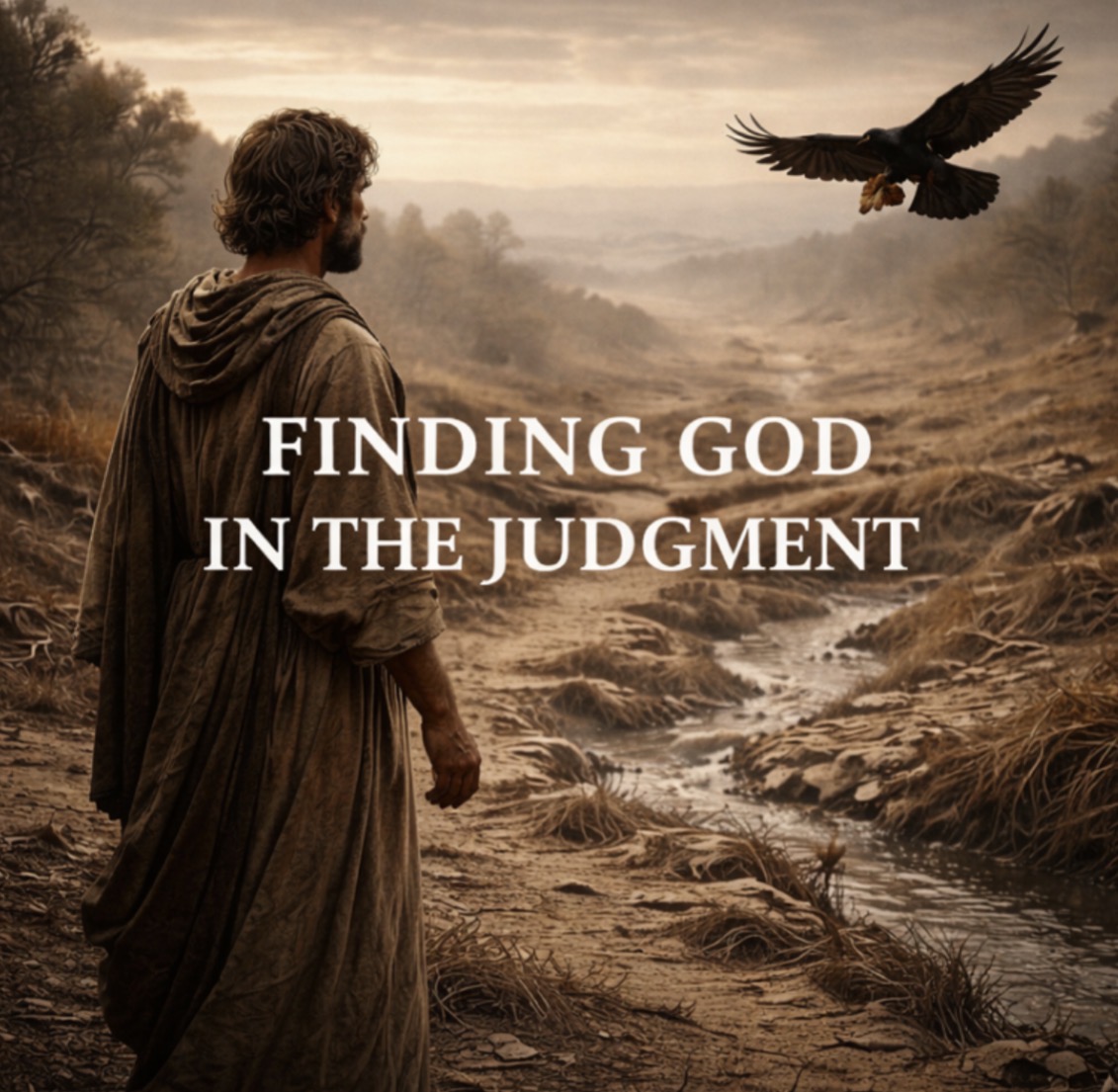
1 Kings 17:4, 6, “I have commanded the ravens to feed thee there… And the ravens brought him bread and flesh in the morning, and bread and flesh in the evening…”
Ravens are unclean birds. Scavengers. They steal food. They do not deliver it. Yet God commands that bird to bring His prophet breakfast and dinner.
On top of that, He did not send a wagon full of supplies. He sent enough for the day. Morning and evening. Then nothing until the next time.
It is the same way He handled manna in the wilderness. Just enough for today. No hoarding allowed.
You feel that in your own life. Just enough strength for today. Just enough wisdom for the next decision. Just enough money to pay this bill, not all the ones you can see coming.
And if I’m honest, we hate that. We want the barn filled and the contingency plan built. God wants faith.
Your weakness, your “just enough,” is not a sign of God failing you. It is the setting where He shows Himself strong. When you know you should be empty and you are not, that gap is where you see God clearly.
4. Shortfalls Help Us Find God in the Judgment
Then something happens that would scare most of us.
1 Kings 17:7–8, “And it came to pass after a while, that the brook dried up, because there had been no rain in the land. And the word of the LORD came unto him, saying…”
The same drought Elijah announced finally hits his own water supply. The brook he has been drinking from shrinks to nothing. If all you look at is the surface, that feels like God dropped him.
But notice the order. The brook dries. Then “the word of the LORD came.”
Elijah had already learned that God could be trusted in tight spaces. So when the water disappeared, he did not throw a fit, he simply waited for direction.
A dried up brook in your life is not proof that God walked away. Often it is a signal that it is time to move. The job that closes, the partnership that ends, the open door that God quietly shuts. It might be the thing that gets you to the next person God wants you to help.
God was not done with Elijah. He was moving him to Zarephath.
5. Helping Others Helps Us Find God in the Judgment
Here is the surprise. God tells Elijah:
1 Kings 17:9, “Arise, get thee to Zarephath… behold, I have commanded a widow woman there to sustain thee.”
If you stopped there, you would think Elijah is going to a rich widow with a pantry full of food. Instead, he meets a woman gathering sticks to cook her last meal.
She tells him she has “a handful of meal in a barrel, and a little oil in a cruse,” then she and her son plan to eat and die.
This is the woman God said would sustain Elijah.
So what does he do? He takes the same faith he learned at Cherith and gives it to her.
He tells her, “Fear not.” He asks her to make him a little cake first, trusting God’s promise that the barrel and the cruse will not fail. That sounds harsh unless you understand what is really going on. God is letting Elijah pull her into the same daily dependence he had just lived.
Elijah came there to be fed, but in the end, God used him more to feed her faith. Her house was supplied, and her son’s life was later restored in that same chapter.
I have watched this play out in real life. You walk into a hospital room or a rest home visit thinking you are the one bringing comfort, and you walk out realizing God did something deep in you while you were trying to help them. In trying to steady someone else, God steadied you.
Helping others in their drought is often where you finally see what God has been doing in your own.
Yes, judgment is real. The moral drought is here. But the God of Elijah has not moved. He is still the God of the palace and the God of the hidden brook. The God of the ravens and the God of the poor widow’s kitchen.
If you are waiting for the world to calm down before you get serious about finding God, you will be waiting forever. Look for Him where you are cut off. Look for Him where you are forced to be still. Look for Him in the weakness that scares you and in the people He puts in front of you to help.
You will find He was there the whole time.