Leviticus is not light reading. Most people rush through it because it feels technical and distant. But when you slow down, you realize God was not just giving Israel health codes, He was teaching them how sin behaves.
Leprosy was not just a rash: it spread, numbed and isolated. It did not stay contained. A small spot could become a consuming infection. That is why God used it as a picture of sin, which works the same way. It rarely announces itself loudly at first. It just starts small, then it settles in.
Miriam spoke against Moses, and leprosy followed. Uzziah lifted himself up in pride, and leprosy rose in his forehead. In both cases, something internal surfaced externally.
Then Leviticus 14 shifts the picture. The plague was not only found in a person. It could show up in a house!
Leviticus 14:41 says, “And he shall cause the house to be scraped within round about, and they shall pour out the dust that they scrape off without the city into an unclean place:”
If a dark streak appeared in the wall, the house was shut up, and it was inspected.
In the New Testament, your body is called the temple of the Holy Ghost. You are the house now. If something begins to spread inside the walls, pretending it is not there will not make it disappear.
The first step was scraping.
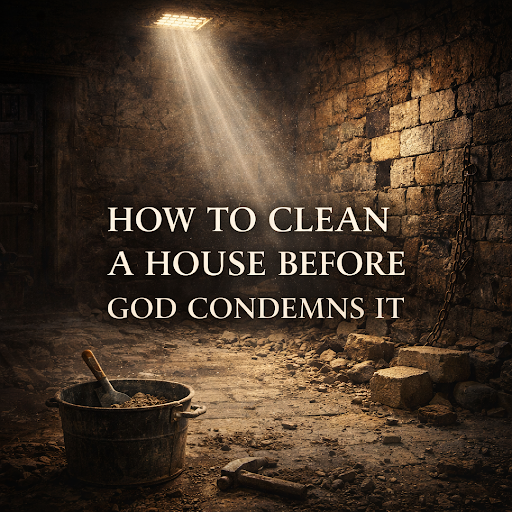
They did not decorate over it or rearrange furniture to hide it. They scraped the walls down and carried the dust outside the camp. That dust represents the residue we excuse. The private habits, tolerated attitudes or small compromises we think no one sees.
Scripture tells us to examine ourselves. That is not comfortable work. It is slow, honest work. But if you do not scrape, the infection settles deeper.
Then came replacement.
Leviticus 14:42 says they removed the affected stones and put new stones in their place. If the infection reached into the structure, the structure had to change.
Sometimes confession alone is not enough. Sometimes the environment has to change. Certain influences have to leave or patterns have to be broken. The New Testament language is simple: Put off the old man and put on the new.
Removal without replacement leaves a hollow space. God never just empties a house, He rebuilds it.
But then comes the sobering part.
If the plague returned after the scraping and the rebuilding, the house was torn down completely.
God was teaching Israel something serious. If sin keeps spreading after repeated mercy, destruction eventually follows. He will not allow corruption to permanently occupy what belongs to Him.
This is was not cruelty, it’s holiness.
Sometimes God allows things to collapse because He will not let a man live comfortably with what is destroying him. He loves the inhabitant enough to remove the structure if necessary.
There was also a period where the house was shut up and nothing moved. A forced pause. The priest waited to see what would happen.
God still does that. He slows you down, creates stillness and gives space for you to look at your own walls without distraction.
The goal was never to condemn the house. The goal was always a cleansing.
Sin spreads when ignored, it weakens when confronted. The scraping is uncomfortable. The replacing is costly. But tearing everything down is worse.
Better to deal with the small dark streak now than to watch the whole structure crumble later.
God is not looking for perfection in your house. He is looking for a heart where He can dwell. If something is spreading, deal with it. Scrape it. Replace what needs replacing. Let Him rebuild what you cannot fix yourself.
He would rather cleanse a house than condemn it.