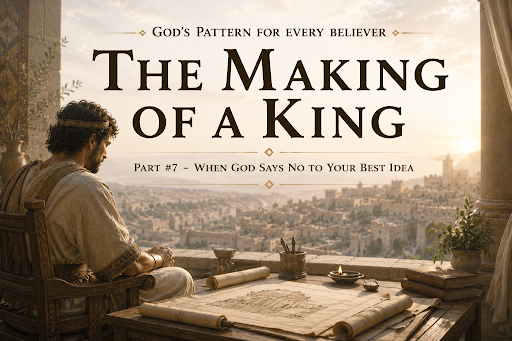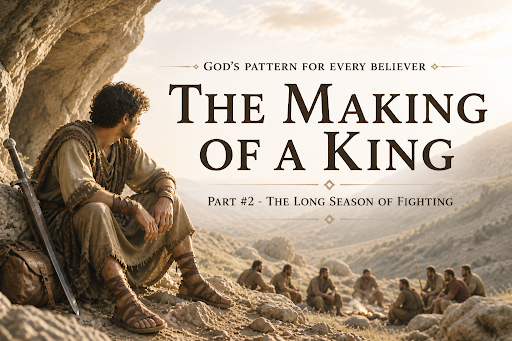
David was anointed king but went back to the sheep. What comes next is not a crown, it’s a process to help him grow into who God wants him to be. Between the anointing and the throne, David fought a giant, served a king who tried to pin him to a wall with a spear, hid in caves, gathered a band of broken men, ran to enemy territory, and watched everything he had burn to the ground at Ziklag. Over a decade of warfare, betrayal, and surviving.
The Christian life is not a straight line to glory. It is a long season of pruning.
Jesus said, “Every branch in me that beareth not fruit he taketh away: and every branch that beareth fruit, he purgeth it, that it may bring forth more fruit” (John 15:2). The word “purgeth” means to prune. God cuts away what shouldn’t be there so what should be there can grow. That is what David went through. That is what every believer goes through. Pruning is not punishment. It is preparation for fruit.
Here are several things we can learn from David’s journey to help us grow as Christians.
1. You will go through seasons where God strips things away.
After salvation, things start to go. Old friends, habits, comforts and old ways of thinking. Some of it is obvious sin. Some of it is not sin at all. Just stuff that was fine before but is holding you back now.
The Bible says, “Wherefore seeing we also are compassed about with so great a cloud of witnesses, let us lay aside every weight, and the sin which doth so easily beset us, and let us run with patience the race that is set before us” (Hebrews 12:1).
Notice it is not just sin that has to go. It is also the weights. A weight is anything that slows you down. It might not be wrong in itself, but if it is keeping you from running the race God has set in front of you, it has to come off. God will strip both. The sin because it is killing you and the weight because it is slowing you. It can feel like you are losing your life. You are being pruned.
David lost the simple life of a shepherd. He lost the safety of his father’s house. He lost his wife Michal when Saul gave her to another man. He lost his reputation, his comfort, and his peace. But every loss was God carving something off him that would have kept him from the throne.
2. You will fight battles you were not expecting.
When you get saved, you think the fight is over. You found Jesus and you are good! Then life hits. The marriage, the kids, the job, and the mind all can become battlefields.
“Fight the good fight of faith” (1 Timothy 6:12). David fought a giant before he ever sat on a throne. He fought Saul, the Philistines and he even almost fought his own men at Ziklag when they turned on him. If you’re a Christian, you will fight too. You will fight to stay faithful to church. You will fight to read your Bible everyday. You will fight to get your family in the house of God. You will fight to give. You will fight to witness. This is a good fight.
The thing most people forget is that everybody is fighting. The question is not whether you are in a fight. The question is which fight you are in. Some people are fighting the good fight. They are fighting to stay faithful to God, to their family, to their church, to the truth. Others are fighting too, but they are fighting on the wrong side. They gave in to the temptation and the world. They are still swinging, just not for God.
3. Not every battle is yours to fight.
Early on, the hardest thing about being a Christian is knowing when to fight and when to be still.
Somebody talks about you at work or a family member says something cutting at the dinner table. A brother at church does you wrong. Your flesh wants to take revenge, but you can’t do that.
David almost destroyed Nabal’s entire household because of an insult (1 Samuel 25). God sent Abigail to stop him from a fight that wasn’t his. Later, David had two chances to kill Saul and take the throne early. Both times he let it go (1 Samuel 24, 26). He knew the throne was God’s to give. Some battles God wants you in, but mostly, He wants you to step back and let Him handle things. “Vengeance is mine; I will repay, saith the Lord” (Romans 12:19).
4. You will be tempted to take shortcuts.
David had two clean shots at Saul. His own men told him God had delivered Saul into his hand. He could have ended his wilderness on his own timing and sat on the throne the next day (1 Samuel 24 and 26).
He refused both times. Every Christian in a hard season gets tempted to shortcut the process. Leaving your family, quitting on church, or dropping your convictions won’t fix anything.
Shortcuts cost you more than going forward ever will. “There is a way which seemeth right unto a man, but the end thereof are the ways of death” (Proverbs 14:12). God is not just trying to get you to the destination. He is building the person who will carry through.
5. You will have to learn to ask God before you act.
One of the clearest patterns in David’s wilderness is how often he “inquired of the Lord” before he moved. Should I go up against the Philistines? (1 Samuel 23:2). Will Saul come down? (23:11). Shall I pursue them? (30:8).
Every major decision, he asked first. Before the wilderness, David killed Goliath on instinct. After the wilderness, he asked first and acted second.
This is growth: You stop trusting your gut and start trusting God’s voice. “If any of you lack wisdom, let him ask of God” (James 1:5). Every believer has to learn this and the wilderness is where it gets built into you.
6. You will have to encourage yourself when nobody else can.
At Ziklag, David had nothing. The city was burned to the ground, all their families were taken, and his own men were talking about stoning him.
With nobody to pick him up or preach to him, the Bible says: “But David encouraged himself in the Lord his God” (1 Samuel 30:6).
There will be seasons where nobody can reach you in the dark place you are in.
You have to go to God yourself and draw strength from Him. That is a skill the wilderness teaches, and every believer has to learn it eventually.
7. The pressure will show you what is really inside of you.
You don’t know what faith is in you until life squeezes you. A hard boss, a sick child, a family member who walks out of your life, or a bank account that’s empty. Those type of things reveal it your faith. “That the trial of your faith, being much more precious than of gold that perisheth, though it be tried with fire” (1 Peter 1:7). Ziklag was David’s squeeze and what came out of him was a prayer of faith. The pressure showed what God had been building in him for ten years. The wilderness is to reveal to what God put in you.
8. The wilderness is not new. God has always used it.
When you get to a hard season and you feel like God forgot about you, He didn’t. God has always used the wilderness to work on hearts. The children of Israel walked forty years in the wilderness before the promised land (Numbers 14:33-34). Moses spent forty years on the back side of the desert before the burning bush. Joseph sat in prison before he stood before Pharaoh. Paul spent years in Arabia before the ministry that changed the world. David’s decade in the wilderness was the road forward. If God has you in a hard season, you are in good company. The wilderness comes before the promised land, every time.
9. Don’t quit in the middle.
The worst thing you can do in a long hard season is stop. Don’t stop going to church, reading your Bible, praying and trusting God. “Let us not be weary in well doing: for in due season we shall reap, if we faint not” (Galatians 6:9). David made mistakes in the wilderness. He ran to the Philistines, faked being insane, and he lied to a priest. He was not without fault, but he kept walking. And in the cave of Adullam, God sent him his mighty men; distressed, in debt, discontented (1 Samuel 22:1-2). Some of the best people God will bring into your life will come when you have the least to offer.
The wilderness has an expiration date and God won’t leave you there forever. But He won’t pull you out early either. The pruning takes as long as it takes. David’s wilderness ended when God said it was time, not a day sooner. God will do the same for you.