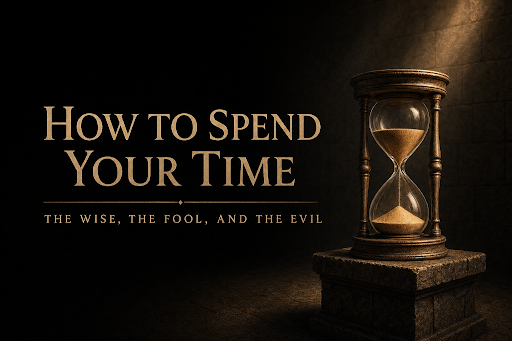
Every Christian has a limited amount of time, energy, and resources. We only get so many hours in a week, so many dollars in a paycheck, so many years on this earth.
How we spend all of that on the people around us matters to God, and the Bible is not silent about it.
Scripture actually gives us a very clear directions for knowing who to pour into, who to correct, and who to walk away from.
Once we see it, a lot of the guilt and confusion we carry about “difficult people” starts to lift, because we finally have a Bible answer for how to handle them.
There are three categories of people in Proverbs and in the New Testament we will look at. The wise, the fool, and the evil.
Each one gets a different response from us, and God gives us the pattern for all three.
The Wise: Give Them Time, Resources, and Energy
A wise person is someone who receives instruction, loves correction, and grows from both. They are not perfect and they do not claim to be. What sets them apart is their response to truth. When they are taught, they listen. When they are reproved, they thank the one who cared enough to tell them. When they are handed a hard word, they take it home, chew on it, and come back sharper. A wise person is teachable, humble, faithful, and fruitful, and every hour poured into them multiplies into more wisdom in them and in the people they touch.
The Bible actually gives us three clear marks of a wise person. If we build the section on those three, the whole thing tightens up.
1. The Wise Receive Instruction
Proverbs 9:9 “Give instruction to a wise man, and he will be yet wiser: teach a just man, and he will increase in learning.”
A wise person takes what is given and grows. Every teaching, every correction, every hard word gets applied. That is why pouring truth into a wise person is never wasted.
2. The Wise Love Reproof
Proverbs 9:8 “…rebuke a wise man, and he will love thee.”
Proverbs 15:31 “The ear that heareth the reproof of life abideth among the wise.”
A wise person does not just tolerate correction. They love the friend who cares enough to tell them the truth. That is how you know where to spend your time.
3. The Wise Sharpen Others
Proverbs 27:17 “Iron sharpeneth iron; so a man sharpeneth the countenance of his friend.”
2 Timothy 2:2 “And the things that thou hast heard of me among many witnesses, the same commit thou to faithful men, who shall be able to teach others also.”
A wise person does not just take truth, they also pass it on. Paul told Timothy to invest in faithful men because faithful men multiply. Iron sharpens iron only when both sides are iron.
The Fool: Give Them Boundaries, Consequences, and Instruction
A fool is not necessarily an evil person. A fool is someone who has not yet learned to respond to wisdom. When truth is spoken, it bounces off. When correction comes, it is ignored or resented. When soft words are given, they do not move him, because his heart has not yet been tenderized by the fear of the Lord (Proverbs 1:7). He is often loud in his own opinions (Proverbs 18:2), quick to anger when confronted (Proverbs 12:16), stubborn in his own way even when it is wrong (Proverbs 12:15), and slow to see the trouble that his choices are causing him and everyone around him (Proverbs 14:16).
A fool is not beyond hope. What he needs is not more soft conversation. He needs clear boundaries, consequences, and steady instruction pointed at the path of the wise.
When a fool finally hears reproof and receives it, he stops being a fool and starts becoming wise. When he refuses correction long enough, he hardens into something worse.
1. The Fool Needs Boundaries
Proverbs 26:3 “A whip for the horse, a bridle for the ass, and a rod for the fool’s back.”
A horse needs a whip to know when to move and an ass needs a bridle to know when to turn. A fool needs a rod to know when he has crossed the line. Different creatures need different tools, and a fool needs firm boundaries, not endless soft words.
Proverbs 26:4-5 “Answer not a fool according to his folly, lest thou also be like unto him. Answer a fool according to his folly, lest he be wise in his own conceit.”
We do not stoop to his level, but we do answer him plainly so he does not walk away thinking he was right.
2. The Fool Needs Consequences
Proverbs 22:15 “Foolishness is bound in the heart of a child; but the rod of correction shall drive it far from him.”
Proverbs 17:10 “A reproof entereth more into a wise man than an hundred stripes into a fool.”
A gentle word does not move a fool. It takes real consequences to get through. This might feel mean, but it’s actually what they need and loving to give it to them.
Consequences are what drive the foolishness out.
3. The Fool Needs Instruction Aimed at the Path of the Wise
Proverbs 15:32 “He that refuseth instruction despiseth his own soul: but he that heareth reproof getteth understanding.”
Galatians 6:1 “Brethren, if a man be overtaken in a fault, ye which are spiritual, restore such an one in the spirit of meekness; considering thyself, lest thou also be tempted.”
The goal is not to punish them, but to restore. Every boundary, every consequence, every reproof is meant to point the fool back to the path of wisdom. A fool who receives correction walks through the door and becomes wise. A fool who refuses correction long enough becomes something worse.
The Evil: Reject and Separate
An evil person, in Bible language a scorner or a wicked man, is not just someone who is struggling with sin. Every Christian struggles with sin at some point. An evil person is someone who has hardened against correction, mocks the truth when it is spoken, and stirs up strife everywhere they go.
Where the fool has not yet learned to respond to wisdom, the scorner has heard wisdom and rejected it, often more than once. When you rebuke him, he does not love you for it. He hates you for it (Proverbs 9:8).
His heart has grown cold to the fear of the Lord, and his mouth and life produce contention, mockery, division, and open rebellion (Proverbs 21:24, Proverbs 22:10, Romans 16:17).
He is not beyond the reach of God’s saving grace, but he is beyond the reach of our continued investment, because Scripture tells us plainly to stop pouring what is holy on ground that will only trample it. Handling an evil person Bible-style is not hatred. It is obedience. It protects the wise, the faithful, and the church itself from being torn down by someone who has already made peace with his own rebellion.
1. The Evil Must Be Marked
Romans 16:17 “Now I beseech you, brethren, mark them which cause divisions and offences contrary to the doctrine which ye have learned; and avoid them.”
Proverbs 22:10 “Cast out the scorner, and contention shall go out; yea, strife and reproach shall cease.”
The first step is honest identification. We do not pretend evil is not evil. We do not soften it into “personality” or “difference.”
God tells us to mark them: Notice them for what they are, name it clearly, and stop letting confusion give them cover. Every home, every Christian, every church needs the courage to see what God is showing them.
2. The Evil Must Be Warned
Titus 3:10-11 “A man that is an heretick after the first and second admonition reject; Knowing that he that is such is subverted, and sinneth, being of his own condemned.”
Proverbs 9:7-8 “He that reproveth a scorner getteth to himself shame: and he that rebuketh a wicked man getteth himself a blot. Reprove not a scorner, lest he hate thee…”
God is patient, but His patience has a Bible-defined limit. Two warnings, then reject. Not seventy times seven for a heretic. We give the warning honestly, and clearly, but we do not pour endless correction into a heart that hates us for it. After the first and second admonition, God changes our marching orders.
3. The Evil Must Be Separated From
1 Corinthians 5:11 “But now I have written unto you not to keep company, if any man that is called a brother be a fornicator, or covetous, or an idolater, or a railer, or a drunkard, or an extortioner; with such an one no not to eat.”
1 Corinthians 5:13 “…Therefore put away from among yourselves that wicked person.”
Psalm 1:1 “Blessed is the man that walketh not in the counsel of the ungodly, nor standeth in the way of sinners, nor sitteth in the seat of the scornful.”
Separation is obedience. God tells us plainly to put away, avoid, and refuse fellowship with the persistently evil. The blessed life begins with not walking, not standing, and not sitting with the ungodly. When the scorner leaves, the strife leaves with him (Proverbs 22:10), and the wise and faithful can finally grow in peace.
What This Means for Us
There are three things I do not want us to miss.
1. God gave us this framework to steward our time well.
We are not judging anyone’s eternal soul. We are stewarding the limited hours God gave us.
Pouring our best hours into a scorner while the wise sit uninvested is bad stewardship. God is not glorified when we spend our lives on people who refuse the truth and neglect the ones who would multiply it.
2. People can move between categories.
A fool can become wise if he receives correction. A wise man can drift into folly if he stops listening. A fool can harden into a scorner if he refuses correction long enough. The category is not permanent. The response to truth is what tells us where someone actually is!
3. Christ is our example.
Jesus poured Himself into faithful men. He corrected the multitudes and rebuked the Pharisees. Even Christ Himself modeled this three part pattern in His own ministry. If
Matthew 7:6 “Give not that which is holy unto the dogs, neither cast ye your pearls before swine, lest they trample them under their feet, and turn again and rend you.”
Every person we know falls somewhere on this map. Wise, fool, or evil. God calls us to invest heavily in the wise, firmly correct the fool, and separate cleanly from the evil.
Where we spend our time is who we become.
Spend it with the wise, correct the fool, and walk away from the evil.