Micah 6 opens with a courtroom scene. God has a controversy with His people and He calls the mountains and hills to hear the case. He reminds them of everything He has done. He brought them out of Egypt, redeemed them from the house of servants, gave them Moses and Aaron and Miriam, and turned Balaam’s curse into a blessing.
Then the people answer back with a question.
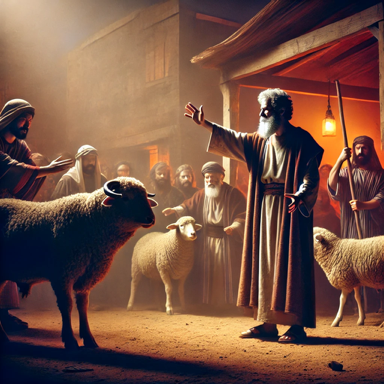
Micah 6:6-7 “Wherewith shall I come before the LORD, and bow myself before the high God? shall I come before him with burnt offerings, with calves of a year old? Will the LORD be pleased with thousands of rams, or with ten thousands of rivers of oil? shall I give the first of my body for the sin of my soul?”
This is not a real conversation. Micah is putting words in the mouth of the average confused Israelite of his day. He is saying, “Here is what you people are thinking. Let me say it out loud so you can hear how ridiculous it sounds.”
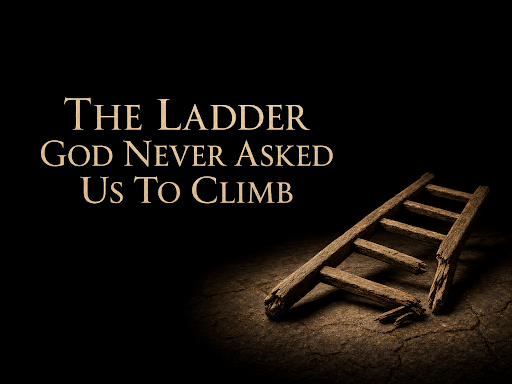
And what comes out is a ladder. Five rungs of escalating sacrifice.
The Five Rungs of the Failed Ladder
1. Burnt offerings: the baseline. The standard sacrifice every faithful Israelite knew.
2. Calves of a year old: the premium. The choicest animal in its prime, representing years of future economic value.
3. Thousands of rams: the extravagant. This was Solomon at the temple dedication offering 22,000 oxen and 120,000 sheep.
4. Ten thousands of rivers of oil: the impossible. Hyperbole so extreme even the worshipper knew nobody could give it.
5. The first of my body: the forbidden. Child sacrifice, which the pagan nations practiced and which God strictly commanded Israel never to do.
Each rung assumes the same wrong idea. If the last sacrifice was not enough, maybe a bigger one will be. Maybe God can be bought if the price is high enough. Maybe if we just find the right number, the right animal, the right amount, God will finally be pleased.
And by the top of the ladder, the worshipper has climbed so high that he has stepped off biblical worship completely and into pagan idolatry. He is offering something God explicitly forbids.
This was not just a thought experiment. Micah was preaching this in the days of King Ahaz.
2 Kings 16:3 “But he walked in the way of the kings of Israel, yea, and made his son to pass through the fire, according to the abominations of the heathen, whom the LORD cast out from before the children of Israel.”
Ahaz literally burned his son as a sacrifice. When Micah says “shall I give the first of my body for the sin of my soul?” the people knew exactly who he was talking about. Their own king had just climbed the top rung of the ladder. And Micah was calling it out. He was saying the king was wrong. God never wanted any of this.
Notice the cold language the worshipper uses too. He does not say “my son.” He does not say “my child.” He says “the first of my body.” He has already emotionally distanced himself. He is treating his firstborn as a religious commodity, not a person. That is what happens when religion becomes transactional. The heart shuts down and people become bargaining chips, similar to someone saying “aborting a clump of cells” today!
God’s Answer Destroys the Whole Ladder
After all the escalation, God’s answer in verse 8 is wonderfully simplistic.
Micah 6:8 “He hath shewed thee, O man, what is good; and what doth the LORD require of thee, but to do justly, and to love mercy, and to walk humbly with thy God?”
God does not want bigger sacrifices, more animals, big jars of oil and absolutely does not want children.
He wants three things:
1. Do justly
2. Love mercy
3. Walk humbly
These three cover everything. They are not three tasks on a spiritual todo list.
– Do justly is our relationship to God’s truth.
– Love mercy is our relationship to other people.
– Walk humbly is our relationship to God Himself.
Every religion in the world tries to build a ladder like the one in Micah 6:6-7. Every religion tries to figure out what will finally please God enough. And God cuts through all of it with these three simple things.
Point 1: Do Justly – Our Relationship to God’s Truth
To do justly means to align our conduct with what God has said is right. Not what the culture calls right or what feels right. And not what most people are doing.
This is why justice is a truth issue before it is a fairness issue. A person cannot do justly without first knowing what God has called just.
Isaiah 33:22 “For the LORD is our judge, the LORD is our lawgiver, the LORD is our king; he will save us.”
God is the lawgiver and justice is measured against His standard, not ours. When Micah says “do justly,” he is telling the people to line up their actions with God’s revealed truth about what is right and wrong.
This covers the moral demands of the whole law. Do not steal, do not bear false witness, do not cheat, do not oppress the poor, do not pervert judgment, and do not respect persons. Every command about doing what is right in the world falls under “do justly.”
Proverbs 21:3 “To do justice and judgment is more acceptable to the LORD than sacrifice.”
God says doing justly is more acceptable than sacrifice. Meaning the everyday choice to act with integrity matters more to God than any offering we could bring to Him.
The danger of justice is what it becomes when it stands alone. Justice without mercy turns into legalism. This was the Pharisee’s error. They knew the rules, they kept the rules and they used the rules to crush people. They tithed mint and anise and cummin while ignoring the hurting person right in front of them. They thought that their version of “keeping the rules” would give them a home in heaven.
Jesus rebuked them for it.
Matthew 23:23 “Woe unto you, scribes and Pharisees, hypocrites! for ye pay tithe of mint and anise and cummin, and have omitted the weightier matters of the law, judgment, mercy, and faith: these ought ye to have done, and not to leave the other undone.”
When Jesus called justice a “weightier matter of the law”, what He meant was it matters more than the ceremonial details. But He also said we should not leave the other undone. Justice must be paired with mercy or it becomes cruelty in the name of righteousness.
A Christian who cares about God’s truth will do justly. But a Christian who only cares about being right and never about the person in front of them has missed the whole point.
Point 2: Love Mercy – Our Relationship to Other People
Mercy is the word used to describe God’s own love for Israel. So when Micah says “love mercy,” he is saying we should love the same kind of stubborn, loyal, promise-keeping love that God shows us.
And notice the verb. Not just “do” mercy, but to “LOVE” mercy. Delight in it, prefer it, want it and enjoy showing it.
It is easy to grit your teeth and be merciful because you have to. It is another thing to actually love being merciful. To find joy in extending grace and to prefer forgiveness over grudge. To want the other person to be lifted up.
This covers the second table of the law. Every command about how to treat other people fits under mercy. Do not murder, do not commit adultery, do not steal, do not lie about your neighbor, and do not covet what belongs to him. All of these are mercy commands at their heart. They are about protecting and honoring other people.
Jesus summed it up.
Matthew 22:39 “And the second is like unto it, Thou shalt love thy neighbour as thyself.”
The whole second half of the law reduces to loving our neighbor. And loving our neighbor means loving mercy toward them.
The danger of mercy is what it becomes when it stands alone. Mercy without justice becomes sentimentalism. This is soft Christianity and is kindness without backbone. Love that never says no. A refusal to call sin what it is because we do not want to hurt anyone’s feelings.
That kind of “mercy” is not really mercy. It is cowardice dressed up as compassion. Real mercy tells the truth and still loves. Real mercy warns of judgment and still holds out the hand of grace.
A Christian who loves mercy will treat other people the way God has treated him. But he will do it with truth in one hand and grace in the other.
Point 3: Walk Humbly with Thy God – Our Relationship to God
Only the third phrase names God directly.
– Do justly (God is not named)
– Love mercy (God is not named)
– Walk humbly “with thy God” (God is named)
Humility only exists in comparison to somebody. Nobody is humble in a vacuum. Humility requires a reference point. And the reference point is God Himself. Without God in the picture, humility becomes just low self-esteem. With God in the picture, humility becomes right-sizing.
“Walk humbly” carries the idea of walking carefully, with constant awareness that God is present. It is not humility as an occasional feeling. It is humility as a way of moving through life. Every step aware that God sees. Every decision made with God in view and every conversation shaped by the knowledge that we are walking with Him.
This covers the first table of the law. Every command about God’s uniqueness, His name, His worship, His day, requires humility. You cannot have any gods before Him unless you first accept that you are not God. You cannot honor His name unless you first bow before it and you cannot rest in His day unless you first admit that your work is not what sustains you.
Jesus put it as the greatest commandment.
Matthew 22:37-38 “Jesus said unto him, Thou shalt love the Lord thy God with all thy heart, and with all thy soul, and with all thy mind. This is the first and great commandment.”
Walking humbly with God is the outward expression of loving Him with everything we have. It is the daily posture of a heart that has bowed.
The danger of humility is what it becomes when it stands alone. Humility without justice and mercy becomes mysticism. It becomes private communion with God that never touches how we act or treat others. It becomes a beautiful inner life that leaves the world unchanged. It becomes a Christian who says the right prayers and reads the right books and feels the right feelings but never actually lives out anything Micah 6:8 requires.
Walking humbly is meant to fuel the other two. When we walk humbly with God, His truth shapes our conduct (do justly) and His mercy shapes our compassion (love mercy). Humility is the source and justice with mercy are the outflow.
And humility is the deepest test of the three. Do justly is what people can see. Love mercy is what people can feel. But walk humbly is what only God can see. You cannot fake humility when nobody is watching.
Here is what makes Micah 6:8 both beautiful and crushing.
Nobody has ever done all three perfectly.
The most just person you know has failed at mercy. The most merciful person you know has failed at justice. The most humble person you know has failed at both at some point.
Micah 6:8 is not just a moral checklist. It is a diagnosis and it shows us how far short we fall.
But then it points beyond itself. Because there was One who did all three perfectly.
Christ was perfectly just. He never sinned, never lied, never cheated, never wronged anyone.
Christ was perfectly merciful. He healed the sick, forgave His enemies, welcomed sinners, wept at gravesides, and gave His life for people who did not deserve it.
Christ walked perfectly humbly with God. He said “not my will but thine be done” and meant it all the way to the cross.
Philippians 2:8 “And being found in fashion as a man, he humbled himself, and became obedient unto death, even the death of the cross.”
He climbed every rung of the failed ladder in Micah 6:7 for us.
– The burnt offering that could never satisfy: He became the offering that satisfied forever.
– The calf in its prime: He was the unblemished Lamb in the prime of His life.
– The thousands of rams: He replaced them all with one sacrifice for all time.
– The rivers of oil: He poured out the Spirit like an infinite river.
– The firstborn son the worshipper could never rightly give: God the Father freely gave His own.
John 3:16 “For God so loved the world, that he gave his only begotten Son, that whosoever believeth in him should not perish, but have everlasting life.”
The ladder Micah’s worshipper tried to climb was never going to reach high enough. It took God Himself coming down to us to solve the problem. And through Christ, His righteousness is counted to us so that God sees us as just, merciful, and humble because Christ was.
Romans 3:22 “Even the righteousness of God which is by faith of Jesus Christ unto all and upon all them that believe: for there is no difference.”
God is not for sale. The whole ladder of Micah 6:6-7 was a lie built on the assumption that we could buy Him off with big enough sacrifices. And God tears the ladder down with one verse.
Do justly. Love mercy. Walk humbly with thy God.
But none of us can do it in our own strength. Which is why the only real answer is to come to Christ. To trust the One who did all three perfectly.
Then, and only then, do we start to live out Micah 6:8. Not to earn God’s love, but because Christ earned it for us and now walks with us through every step.