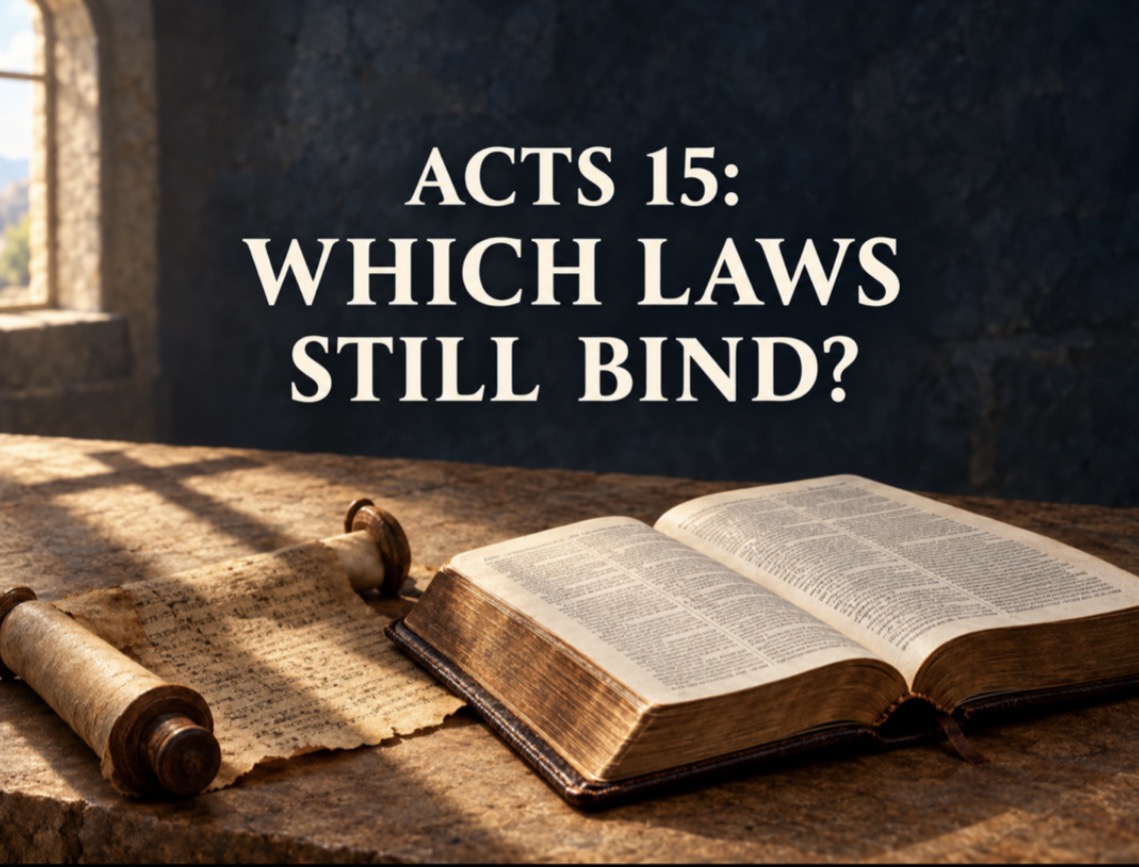
Acts 15:20 “But that we write unto them, that they abstain from pollutions of idols, and from fornication, and from things strangled, and from blood.”
People open the Old Testament and get confused on what laws we are to follow and which ones are nailed to the cross. One page says don’t steal. The next page says don’t wear a garment of wool and linen together. Another tells Israel how to run its courts. So which ones do we follow?
The answer starts with knowing that the Bible does not give us one big pile of laws. It gives us different kinds of law, and each one has a different job.
- The ceremonial law covered the sacrifices, the feasts, the priesthood, and the temple ritual. It was a picture of the coming Christ.
- The civil law was Israel’s government. It covered their courts, their land, and their punishments as a nation under God.
- The moral law is God’s abiding standard of right and wrong. It is the heart of the Ten Commandments, and God wrote it on the heart of every man.
Then before Moses ever went up the mountain, God made a covenant with Noah in Genesis 9. He told mankind to fill the earth. He made human life sacred because man is made in God’s image. And He told them not to eat flesh with the blood still in it.
Acts 15 is where the early church had to sort all of this out. Gentiles were getting saved, and some men from Judaea said they had to keep the law of Moses to be saved. The apostles and elders met in Jerusalem to settle it. What they decided shows us what fell away, what carried over, and what was already universal.
1. THE CEREMONIAL LAW FELL AWAY BECAUSE CHRIST FULFILLED IT
Acts 15:1 “And certain men which came down from Judaea taught the brethren, and said, Except ye be circumcised after the manner of Moses, ye cannot be saved.”
Circumcision was the flashpoint. These men wanted Gentiles to become Jews first and Christians second. Peter stood up and called it what it was.
Acts 15:10-11 “Now therefore why tempt ye God, to put a yoke upon the neck of the disciples, which neither our fathers nor we were able to bear? But we believe that through the grace of the Lord Jesus Christ we shall be saved, even as they.”
The council said no. The ceremonial law was a shadow, and once the real thing arrives you don’t need the shadow anymore.
Colossians 2:16-17 “Let no man therefore judge you in meat, or in drink, or in respect of an holyday, or of the new moon, or of the sabbath days: Which are a shadow of things to come; but the body is of Christ.”
Every lamb on the altar pointed to the Lamb of God. Now that He has come, the ceremonies have done their job.
2. THE CIVIL LAW WAS GIVEN TO ISRAEL BUT ITS PRINCIPLES STILL TEACH US
Notice that the council never even brings it up. Nobody in Acts 15 tells the Gentiles to set up Israel’s courts or follow Israel’s land laws. Those laws were written for one nation that God ruled directly.
Psalm 147:19-20 “He sheweth his word unto Jacob, his statutes and his judgments unto Israel. He hath not dealt so with any nation: and as for his judgments, they have not known them. Praise ye the LORD.”
We are not Israel, and we do not live in a theocracy, so we are not bound to keep every civil statute the way Israel was. But that does not mean we throw those laws out. They came from the same holy God, and the wisdom behind them still stands.
Paul showed us how this works. He took a law about farm animals and pulled a principle out of it for the church.
1 Corinthians 9:9-10 “For it is written in the law of Moses, Thou shalt not muzzle the mouth of the ox that treadeth out the corn. Doth God take care for oxen? Or saith he it altogether for our sakes? For our sakes, no doubt, this is written: that he that ploweth should plow in hope; and that he that thresheth in hope should be partaker of his hope.”
Paul didn’t tell the Corinthians to go find an ox. He showed them that the worker deserves his wages. The civil law is full of truths like that, such as fair weights, honest courts, care for the poor, and protecting life. We don’t keep the statute, but we still learn from the principle.
3. THE MORAL LAW CARRIED OVER BECAUSE IT IS WRITTEN ON THE HEART
The council did not hand the Gentiles the whole law of Moses, but they did not leave them without a standard either. Two of the four abstentions are straight moral law.
Acts 15:29 “That ye abstain from meats offered to idols, and from blood, and from things strangled, and from fornication: from which if ye keep yourselves, ye shall do well. Fare ye well.”
Idols and fornication were the two sins the Gentile world was soaked in. Their temples were full of both. The council put a finger right on the sore spot. That was not new law. It was the first and seventh commandments aimed right at the Gentiles’ biggest temptations.
Romans 2:14-15 “For when the Gentiles, which have not the law, do by nature the things contained in the law, these, having not the law, are a law unto themselves: Which shew the work of the law written in their hearts, their conscience also bearing witness, and their thoughts the mean while accusing or else excusing one another;”
The moral law did not start at Sinai, and it did not end at the cross. God’s standard of right and wrong does not change because His character does not change. We are not saved by keeping it, but a saved heart wants to obey.
4. THE NOAHIC LAW WAS ALREADY UNIVERSAL BECAUSE IT CAME BEFORE MOSES
The other two things to obtain from, things strangled and blood, go back further than Moses. They go back to Noah.
Genesis 9:4 “But flesh with the life thereof, which is the blood thereof, shall ye not eat.”
God gave that word to Noah and his sons, and every nation on earth came from them. So this was not a Jewish rule being forced on Gentiles. It was something God had already said to all mankind. The Jews of that day even had a name for these as the precepts given to the sons of Noah, and they expected Gentiles who lived among them to keep them.
That made these two a bridge. Jewish and Gentile believers were now eating at the same table in the same church. Keeping these simple things kept the peace in the family of God.
Genesis 9:6 “Whoso sheddeth man’s blood, by man shall his blood be shed: for in the image of God made he man.”
The same covenant that guarded the blood of animals also guarded the life of man. Life belongs to God. That was true for Noah, and it is still true for us.
However, the Christian life is not just a list of things to stop. James closed his sentence with this.
Acts 15:21 “For Moses of old time hath in every city them that preach him, being read in the synagogues every sabbath day.”
God’s Word was being read and preached every week, and the believer’s job is to keep going back to it, letting it shape the way we walk.
Psalm 119:105 “Thy word is a lamp unto my feet, and a light unto my path.”
All of these laws point to Jesus Christ. The ceremonies pictured His sacrifice. The civil law showed a holy God ruling His people, which Christ will do perfectly when He reigns. The moral law shows us our sin and drives us to Him for mercy. And the blood that God guarded from Noah’s day on pointed to the blood that would be shed at Calvary.
Romans 10:4 “For Christ is the end of the law for righteousness to every one that believeth.”
You will never keep the law well enough to be saved. Jesus kept it for you and paid for every time you broke it. Trust Him, then walk in the light of His Word. When we understand this, it should make our heart rejoice with gratitudes which should lead to us asking “what more can I do to serve Christ and help others!”