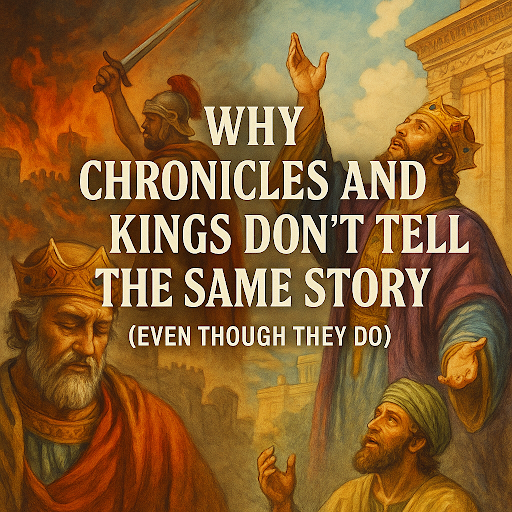
The books of 1 & 2 Kings and 1 & 2 Chronicles cover a lot of the same ground. You’ll read about David, Solomon, Rehoboam, and all the other kings, and you’ll start to think, “Didn’t I just read this?”
You did.
But here’s the interesting part: while the stories overlap, they’re not the same stories. It’s not just a copy-and-paste situation. It’s two different angles, like watching the same ballgame from two different seats.
And the difference in point of view changes your perspective.
Kings Is Man’s View, Chronicles Is God’s
Let’s take a look at it for ourselves:
• Kings was written during or just after the exile to Babylon. It reads like a record of failure. It explains how the people of God fell so far and how judgment came. The tone is heavy. You can feel the weight of disobedience.
• Chronicles was written after the exile, likely by Ezra, when the people were trying to rebuild. It reads like a book of reminders and hope. It skips over a lot of the mess and focuses instead on God’s promises, the temple, and the line of David.
It’s kind of like this:
Kings says, “Here’s what went wrong.”
Chronicles says, “Here’s what God can still do.”
One of the clearest examples is David’s sin with Bathsheba. In 2 Samuel, it’s right there in black and white, his adultery, his cover-up, his failure as a father and king. But in 1 Chronicles?
Gone.
God chose to not highlight it. Chronicles focuses on David as the man God used to bring the ark back and prepare for the temple. It shows the spiritual legacy, not the personal failures.
This is not about hiding sin, it’s about showing grace.
In 2 Samuel 6, Michal is called “Saul’s daughter and David’s wife.” But in 1 Chronicles 15:29, she’s just called “Saul’s daughter.” That’s no accident. God was showing whose side she was really on.
She mocked David’s worship, and the Lord didn’t forget that. Chronicles makes it plain: she lined up more with Saul than with the man after God’s own heart.
One of the most amazing changes happens with King Manasseh.
In 2 Kings 21, he’s flat-out wicked. He filled Jerusalem with blood. There’s not one good word said about him. But Chronicles tells a secret:
“And when he was in affliction, he besought the LORD his God… then Manasseh knew that the Lord he was God.” (2 Chronicles 33:12–13)
He repented. He got right. He got restored.
That’s story is not in Kings at all. God made sure His side of the story got told in Chronicles.
• Kings shows the fall, Chronicles shows the fix.
• Kings shows what men remember, Chronicles shows what God remembers.
• Kings explains the judgment, Chronicles restores the hope.
Chronicles was written to help the people who came back from captivity. It showed them how God had worked before, and gave them hope to try again. It’s a book for people getting back up.
If you’ve messed up, Kings might describe how you got there. But Chronicles reminds you it doesn’t have to end that way.
God doesn’t rewrite history. But He does redeem it.