We often remember Job for his suffering or his patience, but we shouldn’t overlook his role as a father. Job was a man who knew how to balance a busy life. He was a pillar of his community, known for strengthening others and stepping in when people were falling apart.
Job 4:3-4, “Behold, thou hast instructed many, and thou hast strengthened the weak hands. Thy words have upheld him that was falling, and thou hast strengthened the feeble knees.”
Job was a “helper.” He spent his days fixing other people’s problems. But he didn’t make the mistake of helping the world while losing his own house. He took the same energy he used to help his neighbors and focused it on the spiritual health of his ten children.
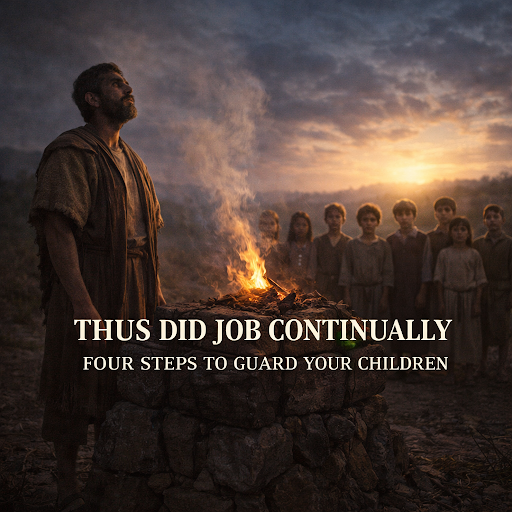
In Job 1:5, we see a specific, four-step pattern that Job followed. It says: “And it was so, when the days of their feasting were gone about, that Job sent and sanctified them, and rose up early in the morning, and offered burnt offerings according to the number of them all… Thus did Job continually.”
1. He Sent for Them
Job didn’t just wait for his kids to show up. He was proactive. He “sent” for them. He made it clear that their spiritual life was a priority. He reached out and brought them into a space where God was the focus.
2. He Sanctified Them
To “sanctify” means to set something apart for a holy use. Job wanted his children to understand that they weren’t just like everyone else in the world. He taught them that their lives belonged to God and that they needed to be clean and prepared to meet Him.
3. He Set a Time
Job “rose up early in the morning.” This wasn’t a random event; it was a scheduled priority. He didn’t fit God in when he had a gap in his business schedule. He gave God the first and best part of his day.
4. He Sacrificed with Them
He offered burnt offerings for every single one of them. He showed them the cost of sin and the necessity of a sacrifice. He put his own resources on the altar for his children’s sake.
How We Do This Today
If we expect our children to grow up godly just because we send them to a Christian school or drop them off at a church youth group, we are mistaken. You cannot delegate the spiritual leadership of your home to an institution. Children are watching your example, not just your Sunday morning “church face.”
We need to apply Job’s four steps in our homes:
* Call Them Together: We need to “send for them” by having a dedicated Bible time in our house. We should gather around the Word as a family, not as an afterthought, but as a primary event.
* Set Them Apart: We need to “sanctify” them by teaching them how to live differently than the world. We set them apart for holy use by showing them how to guard their eyes, their ears, and their hearts. We must guard them from electronics, friends and relatives. If someone or something will harm them spiritually, it’s our job to remove that from their lives.
* Have a Set Time: If you only talk about God when there is a crisis, your kids will learn that God is a “spare tire” rather than the “steering wheel.”
* Sacrifice Together: We should serve in ministry together. Whether it’s going out soul-winning, working the bus route, or helping in the rest home ministry, our kids need to see that serving God costs us something. It costs our time, our talents, and our treasures.
The Secret is the “Continually”
The most important part of Job 1:5 is the very last phrase: “Thus did Job continually.”
Job wasn’t a “Phase Christian.” He didn’t do this for a week and then get bored. He didn’t do it only when he felt inspired. He did it faithfully, day in and day out, through the good times and the bad.
Consistency is the loudest sermon you will ever preach to your children. If you want them to be faithful to God when they are thirty, they need to see you being faithful to God while they are ten. Don’t leave their souls to chance. Follow the pattern, pay the price, and do it continually.
We have to be honest about how this story ends.
Job’s faithfulness in these four steps did not provide his children with a “bubble” of physical protection. In a single, tragic afternoon, a great wind came and took the lives of all ten of his children. If we serve God only to get a physical insurance policy, we have missed the point of the Bible.
Job did not sacrifice so they would be rich or safe from storms; he sacrificed because he was concerned about their souls. He knew that the physical world is temporary, but the spiritual state is eternal. By sanctifying them and leading them to the Lord “continually,” Job ensured that while he lost them for a season on earth, he did not lose them forever. He helped them be saved spiritually, pointing them to the Lord so that even when the worst tragedy imaginable struck, their souls were secure if they trusted in the one their sacrifices pointed to: Jesus.
Our job as parents isn’t just to keep our kids safe until they are eighteen; it is to introduce them to the Savior so they can call upon him for salvation.