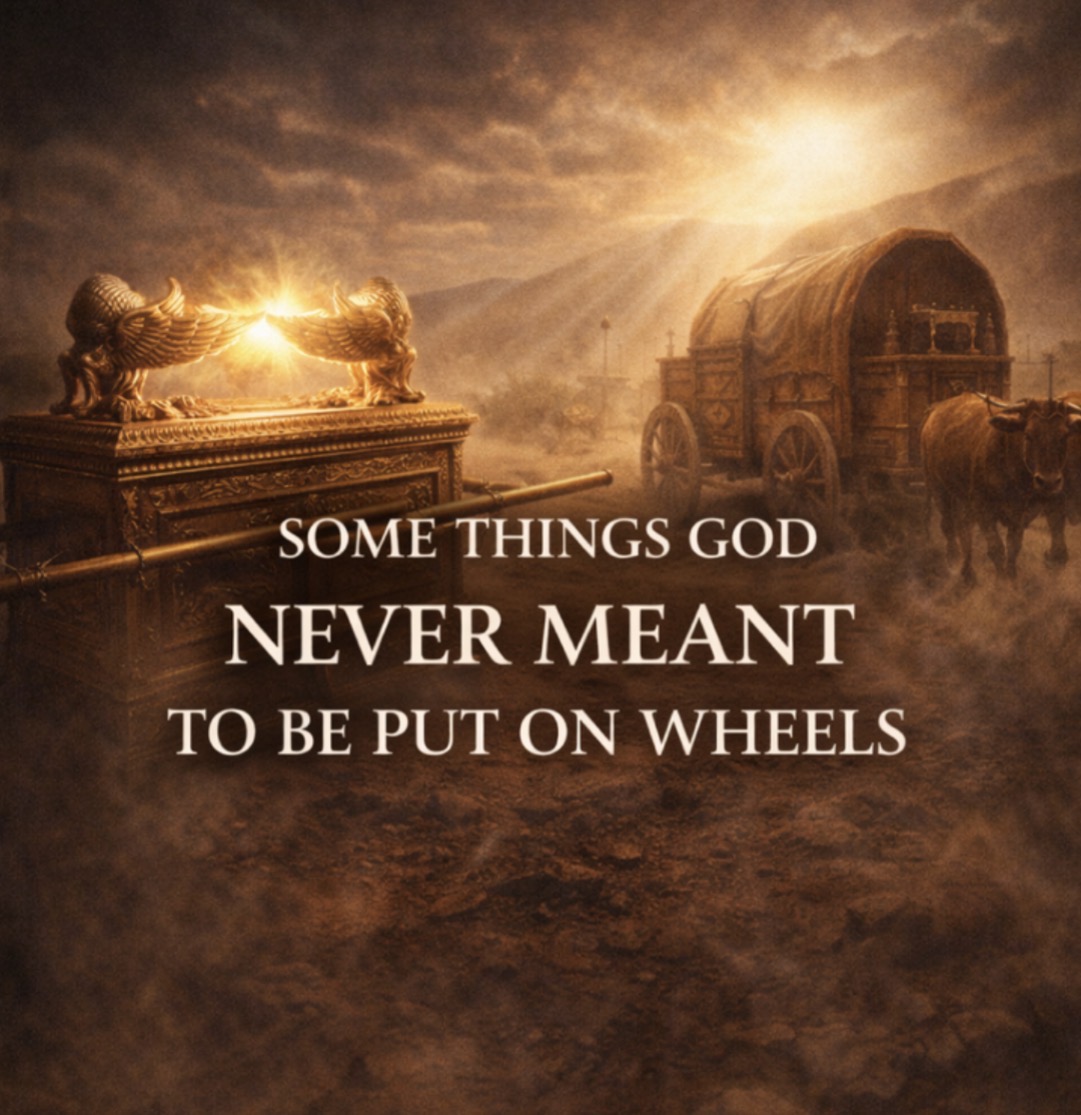
In the book of Numbers, we see a massive operation. Moving the Tabernacle through the wilderness was a logistics nightmare, but God gave a specific plan for it. In Numbers chapter 7, the leaders of Israel bring a gift to help with the move: six covered wagons and twelve oxen.
Moses takes the wagons and divides them among the Levites. He gives two wagons to the sons of Gershon and four wagons to the sons of Merari. But when he gets to the sons of Kohath, he gives them nothing. No oxen, wheels, or help.
Numbers 7:9, “But unto the sons of Kohath he gave none: because the service of the sanctuary belonging unto them was that they should bear upon their shoulders.”
The holiest objects in the Tabernacle, the Ark, the Table of Shewbread, the Altars, were not allowed to be put on carts. They had to be carried on shoulders. No shortcuts or easy conveniences.
This was a picture of how God expects us to handle the sacred.
The Structural Things Can Roll
The sons of Gershon and Merari were responsible for the “heavy lifting” of the structure. They carried the boards, the pillars, the heavy sockets, and the long curtains. God allowed wagons for those.
In ministry, there are plenty of things that can be, and should be, systematized. We use budgets, building programs, logistics, and software. In the New Testament, these are the “helps and governments” (1 Corinthians 12:28). Structure matters and efficiency is not a sin. God actually provided the wagons for the boards.
The Holy Things Must Be Carried
But the “service of the sanctuary” was different. The holiest items couldn’t be put on wheels because proximity creates weight. When you carry something on your shoulders, you feel it.
You are directly under it. You have to move carefully because you cannot detach yourself from the load.
This is the picture of sacred responsibility. In our walk today, things like Doctrine, the Gospel, and Spiritual Authority are not meant to be put on wheels.
1 Timothy 6:20, “O Timothy, keep that which is committed to thy trust, avoiding profane and vain babblings…”
You cannot automate reverence, you cannot systematize holiness, and you cannot delegate your personal responsibility for sacred truth to a program or a personality. Some things are meant to be felt.
David’s Mistake: Sincerity vs. Method
Years later, King David tried to move the Ark of God. He wanted to do it right, so he built a “new cart.” It looked respectful and it was efficient. It was exactly how the Philistines had moved it earlier. But as the oxen stumbled, a man named Uzzah reached out to steady the Ark and died on the spot (2 Samuel 6:6–7).
The lesson is sharp: Good intentions do not override clear instructions. The Philistines used a cart because they didn’t know any better. David used a cart because he wanted convenience. He tried to move a holy thing like it was common furniture. When we try to carry the presence of God using the world’s entertainment methods or branding tricks, we are making David’s mistake.
The Shoulder Principle
The Kohathites carried the weight on their shoulders. Interestingly, the Bible says of Christ in Isaiah 9:6 that “the government shall be upon his shoulder.” True leadership in Scripture is always weight-bearing!
We live in a world that wants to streamline everything. We want “push-button” Christianity.
But some things cannot be outsourced to technology or outsourced to a committee.
* Personal Holiness must be carried.
* Handling Scripture (preaching & teaching) must be carried.
* Prayer and Intercession must be carried.
* Soul winning and discipleship must be carried.
* Our homes and families must be carried.
God allowed carts for the structure, but He forbade carts for His presence. If you try to put holy things on wheels, you will eventually find yourself trying to “steady” God with your own hand when the road gets bumpy. That never ends well.
Not everything in the Christian life is supposed to be easy. Some things must be carried close. The question is: what are you trying to put on wheels that God intended for you to carry on your shoulders?