2 Samuel 5:6-10, ”And the king and his men went to Jerusalem unto the Jebusites, the inhabitants of the land: which spake unto David, saying, Except thou take away the blind and the lame, thou shalt not come in hither: thinking, David cannot come in hither. Nevertheless David took the strong hold of Zion: the same is the city of David. And David said on that day, Whosoever getteth up to the gutter, and smiteth the Jebusites, and the lame and the blind that are hated of David’s soul, he shall be chief and captain. Wherefore they said, The blind and the lame shall not come into the house. So David dwelt in the fort, and called it the city of David. And David built round about from Millo and inward. And David went on, and grew great, and the Lord God of hosts was with him.”
David is finally king over all Israel. He has been waiting for this moment for over twenty years.
After being anointed as a boy in his father’s house, after running from Saul through the wilderness, after seven and a half years reigning in Hebron over only one tribe, the day has finally come where every tribe is under him and the kingdom is whole. Now the question is what will he do first.
He could have built himself a palace and rested for a while. He could have thrown a feast and let the country celebrate him. He could have gone after the Philistines who had been a thorn in Israel’s side his entire life.
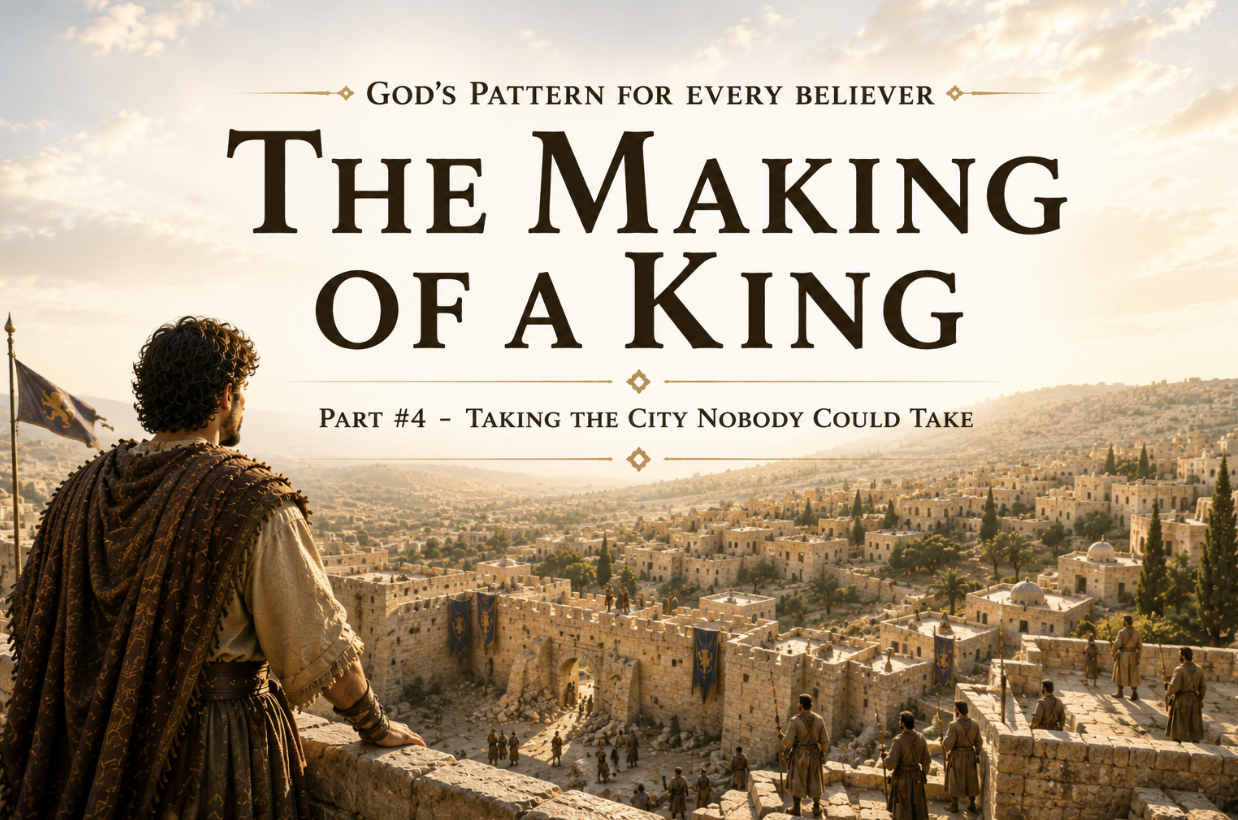
The very first thing David did as king over all twelve tribes was march on Jerusalem.
Now Jerusalem at that time was not really Jerusalem. It was Jebus. It belonged to the Jebusites, a Canaanite people who had been holding that fortress for around four hundred years. Joshua killed the king of Jerusalem back in his day, but the Israelites never finished the job (Joshua 10).
The men of Judah burned the city once, but the Jebusites came right back and lived in it again (Judges 1:8). The tribe of Benjamin could not drive them out either (Judges 1:21). For four hundred years, that city stood as a stronghold inside Israel’s own border that nobody could take.
It sat on a narrow ridge with steep drops on three sides and a wall around the top.
When David and his army showed up, the Jebusites mocked him from the wall. “Except thou take away the blind and the lame, thou shalt not come in hither” (2 Samuel 5:6). They were saying that even their crippled and blind could defend the wall against the king of Israel. That is how confident they were. Four centuries of holding that city had convinced them that nothing was getting in.
David did not argue or negotiate. He told his men, “Whosoever getteth up to the gutter, and smiteth the Jebusites… he shall be chief and captain” (2 Samuel 5:8).
The gutter was the water shaft, the underground tunnel the Jebusites used to bring water up from the Gihon Spring outside the wall. Joab, the son of Zeruiah, climbed up that shaft, came up inside the city, and the fortress fell. Four hundred years of impossibility undone in one day. “Nevertheless David took the strong hold of Zion: the same is the city of David” (2 Samuel 5:7).
Every Christian has a Jebus. Something that has been standing inside your life for years that nobody has been able to bring down. It might be a sin you cannot seem to break, a stronghold in your mind, or a family pattern that runs back two or three generations.
It looks impossible because for years and years it has been impossible. The voices around you, and the voice inside you, are saying that you will never get in there and will never beat this thing.
But the same God who handed David that fortress in one day is the same God you serve.
What has stood for four hundred years can fall on the day God says it falls. The walls, the reputation, or the history of failure does not matter. When God moves, the impossible falls.
Here are four things from David taking Jerusalem that line up directly with the strongholds you and I face today.
1. There Is Something in Your Life That Has Stood for Too Long
For Israel, the Jebusite fortress in Jerusalem was that something. Joshua tried to deal with it and only got partway. The men of Judah tried after him. The tribe of Benjamin lived right next to it and could not push them out. Generation after generation of God’s people walked past those walls and decided to live with the problem rather than do anything about it. They got used to it and just worked around it. They made peace with a stronghold sitting in the middle of their inheritance.
Most of us have a Jebus in our own lives. For some, it’s pornography. For others, it’s anger. It might be anxiety, gossip, bitterness, or poor thinking you inherited.
Something that has been there so long it feels like part of who you are. You know it shouldn’t be there, but you can’t get rid of it!
It is not part of who you are. It is a stronghold sitting inside your inheritance, and it does not belong there. The Apostle Paul wrote, “For the weapons of our warfare are not carnal, but mighty through God to the pulling down of strong holds” (2 Corinthians 10:4). God gave you weapons that work!
2. The Enemy Will Tell You It Cannot Be Done
The Jebusites mocked David from the top of that wall. Their whole defense was to laugh at him. “The blind and the lame can keep you out.”
Notice how confident they were. Four hundred years of winning had given them every reason to believe nothing was different this time.
The devil does the same thing to you. He has watched you fail at this stronghold for years. He has whispered the same lie at you the entire time. You will never beat this, everybody in your family is like this, and this is just who you are.
You have tried before and look how that ended. He has been saying it so long that you started saying it back to yourself. The voice telling you it cannot be done is not God’s voice. It is the voice on top of the wall trying to keep you out of what already belongs to you.
Paul told Timothy, “For God hath not given us the spirit of fear; but of power, and of love, and of a sound mind” (2 Timothy 1:7). The fear that tells you the wall is too tall is not from God. Stop listening to it.
3. God’s Way In Is Rarely the Front Door
David did not break down the front gate. He went up the water shaft. The Jebusites had spent four hundred years defending the obvious approach and they never thought twice about the way underneath. God’s plan to take the city went through the place nobody was watching.
God’s strategies for breaking the strongholds in your life often look the same way. You have probably been trying to fight your stronghold in exactly the same way for years. White knuckling it and just trying harder. You make promises, set up rules and you keep getting nowhere because you are attacking the front gate of something that has been built to withstand exactly that.
Maybe God is showing you a different way in. The answer is scripture in the morning instead of willpower at night. It is accountability with another believer instead of trying to fight it by yourself.
It is finally getting honest with your spouse instead of hiding it for another year. As Christians, we fight on our knees!
The Bible says, “For my thoughts are not your thoughts, neither are your ways my ways, saith the Lord. For as the heavens are higher than the earth, so are my ways higher than your ways, and my thoughts than your thoughts” (Isaiah 55:8-9). Ask God how He wants you to go at this thing. I promise you, He has a way in.
4. God Gets the Credit When the Wall Falls
Look at how the passage ends. “And David went on, and grew great, and the LORD God of hosts was with him” (2 Samuel 5:10). David did not take Jerusalem. The Lord God of hosts took it through David. The credit goes to the Lord, and the writer of Samuel makes sure we know it.
When the stronghold in your life finally comes down, it will not be because you finally got strong enough, or disciplined enough, or smart enough, or spiritual enough. It will be because God broke it. Give Him the credit and tell people what He did.
The testimony of how God broke something in your life that had stood for years is one of the most powerful things you can carry into a conversation with somebody who is still living under their own four hundred year wall. “Let the redeemed of the Lord say so” (Psalm 107:2). Don’t be quiet about it. Tell people what God did.
There is something standing in your life right now that the world says is permanent. A wall four hundred years old. A pattern, a sin, a wound, or a fear. Everybody has learned to live with it, including you. But David walked into Jerusalem and that wall came down. Joab went up the water shaft and a city that had never fallen was gone in a day.
Ask God to show you the way in. The wall is not as strong as it looks.