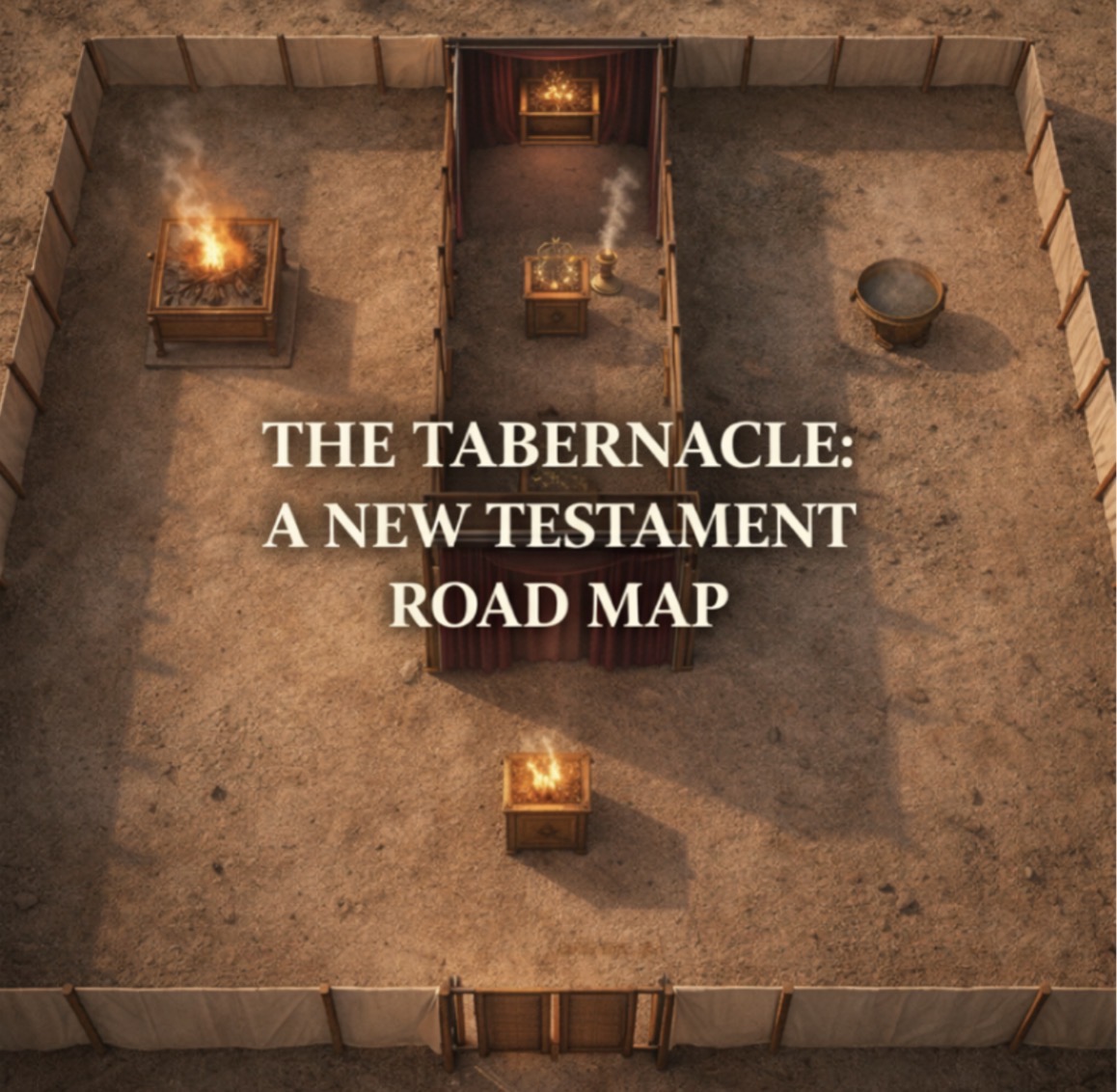
Hebrews tells us the Tabernacle was a pattern of heavenly things. God was teaching Israel with wood, fabric, blood, and fire. What they walked through physically, we now walk through spiritually in Christ.
For the New Testament believer, the Tabernacle is not a relic. It is a road map. It shows how God brings a sinner from guilt to grace, and from distance to daily fellowship.
You never started where you are now. You came a certain way.
Where access begins
Nobody entered the Tabernacle by accident. You started in the outer court.
The first thing you met was the brazen altar. That altar dealt with sin. Blood was shed there, not feelings, not effort, not promises to do better. Think of a butcher market where thousands of animals were slaughtered.
In the New Testament, that altar is the cross. Christ was offered once, and it never needs repeating.
Hebrews 13:10 says, “We have an altar, whereof they have no right to eat which serve the tabernacle.”
Before worship, before service, before growth, there is Calvary. If you skip the altar, nothing else matters.
After the altar came the laver. The priests washed there before they served. The altar dealt with guilt. The laver dealt with defilement. That is the Word of God in a believer’s life. Salvation is settled at the cross and fellowship is kept clean by the Word.
Ephesians 5:26 calls it the washing of water by the word. You do not get saved again. You get cleaned up to walk again.
Where daily life is lived
Past the outer court was the holy place. Only priests went in there. Under the New Testament, every believer is a priest.
Inside that room was light, food, and prayer.
The candlestick burned with oil. If there was no oil, there was no light. Christ is the Light of the world, and the Spirit is the oil that keeps the flame burning. A believer without the Spirit’s leading is walking in shadows, even if they know the layout.
The table of shewbread held fresh bread at all times. There were two stacked loafs of six. Six and six. Our Bible has sixty six books.
Yesterday’s bread was not enough. Neither is yesterday’s time with God. Jesus said He is the Bread of life, and a Christian who tries to live on old feeding grows weak fast.
The altar of incense stood before the veil. Morning and evening, the smoke rose up. It was steady and constant. That is prayer. This is praying without ceasing. A life that stays in communication with God does not drift far from Him.
What Was Removed
Between the holy place and the presence of God was the veil. Thick, heavy and untouchable.
When Christ died, God tore it. Not from the bottom up. From the top down. God removed what man could never remove.
Hebrews 10 says we now enter by a new and living way, through the veil, that is to say, His flesh. Access is not earned, it is opened.
Where God Meets Man
Inside the most holy place was the ark. Inside the ark was the law that condemned. On top of the ark was the mercy seat where blood was applied.
God never ignored the law. He satisfied it.
Because Christ is our propitiation, the law no longer condemns those who are under the blood. God does not see a sinner standing alone. He sees the blood between Himself and the law.
That is why fellowship is possible, because Christ finished the work.
The Priest Who Made It Permanent
Aaron went in once a year with fear. Christ went in once forever with His own blood.
Hebrews 4:14 says, “Seeing then that we have a great high priest, that is passed into the heavens, Jesus the Son of God, let us hold fast our profession.”
Our High Priest is not nervous. He is seated.
The Picture God Wanted Us To See
The Tabernacle was never random.
You start at the altar.
You stay clean at the laver.
You walk in the light.
You feed on the bread.
You pray at the altar.
You live with access to God Himself.
Those were shadows. Christ is the substance.
God still brings people the same way. From the cross, into the Word, through daily dependence, and into steady fellowship with Him