It is easy to make a commitment when we are excited about what God is doing. We volunteer to serve, decide to give, or take on a responsibility, and we mean every word. Then our circumstances change and keeping that commitment costs more than we expected.
The work gets harder, the results come slower, and we have reasons to stop that we did not have when we started. Now we have to decide whether we will keep doing what we believed God wanted us to do.
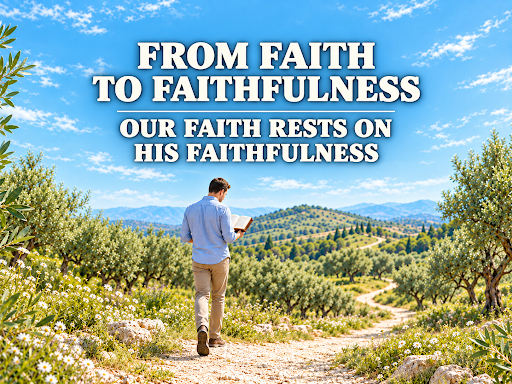
That is where faith should produce faithfulness. We keep following because we trust God more than we trust our circumstances to tell us what is right.
Hebrews 10:23 “Let us hold fast the profession of our faith without wavering; (for he is faithful that promised;)”
Our circumstances may change, but we still have reason to trust the One we are following.
Hebrews 11:11 “Through faith also Sara herself received strength to conceive seed, and was delivered of a child when she was past age, because she judged him faithful who had promised.”
Notice how the verse connects faith and faithfulness. It begins with “Through faith” and explains why: “because she judged him faithful who had promised” (Hebrews 11:11).
Our faith rests on His faithfulness. Before we talk about becoming more faithful ourselves, we need to consider the God we are trusting. If God is as good as we say He is, we should have every reason to trust Him!
She Considered The One Who Promised
The verse describes Sarah as past the age of childbearing, yet it places her confidence in the faithfulness of the One who had promised (Hebrews 11:11). Her circumstances presented a difficulty, but God’s character gave her reason to believe Him.
This is faith in the faithfulness of a promising God. That is a wonderfully simple way to put it. Faith has somewhere to rest because God can be trusted.
We often begin in the other direction. We examine our circumstances, measure our ability, and then try to decide whether we have enough faith to make everything work.
That can leave us watching ourselves all day.
* Do I feel confident enough?
* Am I worried too much?
* Why does someone else seem so much stronger than I am?
There is a place for examining ourselves, but we cannot build confidence in God by thinking only about ourselves. We need to consider what He has said and whether we believe He will keep His Word.
The question becomes, “Who made the promise?” That brings our attention back to Him.
He Was Faithful Before We Trusted Him
Lamentations 3:22-23 “It is of the LORD’S mercies that we are not consumed, because his compassions fail not. They are new every morning: great is thy faithfulness.”
These words appear in a passage that speaks openly about affliction and misery, followed by a deliberate remembrance that brings hope (Lamentations 3:19-23).
The confession of God’s faithfulness comes in the middle of suffering.
That matters when we are tempted to make our circumstances the measure of God’s character. A hard week can make us talk as though every previous mercy has disappeared.
One unanswered question can take up more room in our thinking than years of reasons to thank Him.
We do not make God faithful by believing in Him. Our trust is a response to His faithfulness, and our feelings do not determine whether He is worthy of that trust.
Lamentations 3:24 “The LORD is my portion, saith my soul; therefore will I hope in him.”
The hope expressed here rests in the Lord Himself (Lamentations 3:24). We need that kind of confidence when there are things we cannot explain and burdens we cannot remove.
We can acknowledge that something hurts without deciding that God has failed us. We can bring Him our questions while continuing to trust His character.
Sometimes we need to put our complaint beside what we still have reason to thank Him for. The difficulty may be real, but it should not be the only thing we remember. We can pray honestly about what hurts and deliberately give thanks for the mercy we have received.
That does not require pretending everything is easy. It requires refusing to let one part of our experience become the whole of our testimony. We have more to consider than the problem immediately in front of us.
Trust Him Before You Know The Outcome
Hebrews 11:8 “By faith Abraham, when he was called to go out into a place which he should after receive for an inheritance, obeyed; and he went out, not knowing whither he went.”
Abraham had a call from God before he had knowledge of the destination, and he obeyed (Hebrews 11:8). His limited understanding did not make God’s call less trustworthy.
We like to reverse that order. Explain the whole plan, remove the risk, let us see how everything ends, and then we will decide whether to follow.
But there are decisions where we already know what is right and still do not know what will happen afterward. We know we should tell the truth, but we do not know how someone will respond. We know we should admit our wrong, but we cannot guarantee that the conversation will be easy.
Trusting God reaches into those decisions. We can obey what He has made clear without requiring Him to explain everything He has not.
That does not make every uncertain idea a call from God. Abraham responded to God’s call, and we need to distinguish what Scripture requires from something we simply want to try (Hebrews 11:8).
Believe The Promise He Actually Made
Sarah’s faith concerned a promise God had made, not an outcome she had decided He owed her (Hebrews 11:11). We need to be careful about that distinction.
We can want something so badly that we begin treating our desire as a promise. Then, if it does not happen, we feel betrayed by a commitment God never made.
Faith does not give us permission to write His promises for Him. We need to read what He has said, understand it in its setting, and trust Him with the things He has not promised to explain.
For example, Scripture does give us this assurance:
1 John 1:9 “If we confess our sins, he is faithful and just to forgive us our sins, and to cleanse us from all unrighteousness.”
Notice that forgiveness is connected to His faithfulness and justice (1 John 1:9). When we confess our sins, we have His Word to trust, even while we feel ashamed.
There is a difference between asking God to make our preferred plan happen and depending on Him to do what He has actually promised. The first can become a demand. The second gives our faith something solid to rest on.
When we read the Bible, we should slow down enough to ask what a passage actually says.
* Who is being addressed?
* What is promised?
* Is there a command we need to obey?
Careful reading protects us from calling our own expectations faith and then blaming God when those expectations disappoint us.
His Faithfulness Is Our Reason To Hold Fast
Hebrews 10:23 “Let us hold fast the profession of our faith without wavering; (for he is faithful that promised;)”
The verse gives both the instruction and the reason: hold fast because the One who promised is faithful (Hebrews 10:23). Our continued trust is tied to His character.
He never changes his mind, and He never forgets his word.
What are we waiting to understand before we obey? What part of God’s Word have we treated as less dependable than our fears?
We may still have unanswered questions tomorrow and we may still feel the weight of the same responsibility. But we can return to what God has said and take the next step because the One who spoke can be trusted.