Part 2: Deflect It
My kids have a script. When one of them gets caught doing something wrong, the first words out of their mouth are almost never “I did it.” The first words are “But he did…” or “But she started…” The finger goes up before the confession does almost every single time.
They do not learn this from a book or class. They come out of the womb doing it, because it is written on the human heart from the fall. When Adam got caught, he blamed Eve and God in the same sentence. When Eve got caught, she blamed the serpent.
And if we are honest, we still do this as grown Christians. We just use bigger words for it.
That is the second D of dealing with our failure: Deflect It.
Proverbs 19:3 “The foolishness of man perverteth his way: and his heart fretteth against the LORD.”
A man makes his own mess, then his heart gets angry at God for it. He caused the problem, and he is blaming the One who tried to warn him away from it.
Aaron and the Golden Calf
The second great deflection in Scripture is Aaron with the golden calf.
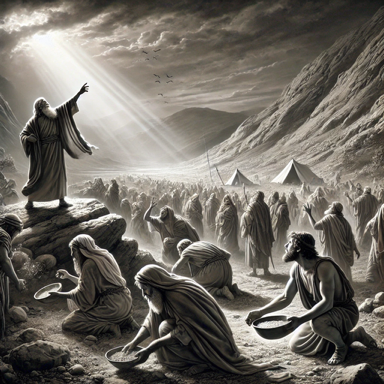
Moses came down from the mountain and found the whole camp of Israel worshipping an idol Aaron had personally made. Aaron had taken the gold, shaped it, built the altar and had called for the feast. Every step of the disaster had Aaron approval and leadership.
But when Moses confronted him, listen to what he said:
Exodus 32:22-24 “And Aaron said, Let not the anger of my lord wax hot: thou knowest the people, that they are set on mischief. For they said unto me, Make us gods, which shall go before us; for as for this Moses, the man that brought us up out of the land of Egypt, we wot not what is become of him. And I said unto them, Whosoever hath any gold, let them break it off. So they gave it me: then I cast it into the fire, and there came out this calf.”
As if the calf just walked out of the fire on its own. He blamed the people for asking and he blamed the fire for producing. He blamed everyone except the man who actually shaped the idol.
Aaron is a picture of the Christian who cannot say “I did it.” Even standing next to the evidence, he found a way to pass the blame down the line.
Saul and the Sacrifice
Saul was told by Samuel to wait seven days before offering the sacrifice. Samuel would come and offer it himself. Saul’s only job was to wait.
But Saul did not wait. He got impatient, he saw his men scattering, and he offered the sacrifice himself. And when Samuel showed up right after, Saul deflected.
1 Samuel 13:11-12 “And Samuel said, What hast thou done? And Saul said, Because I saw that the people were scattered from me, and that thou camest not within the days appointed, and that the Philistines gathered themselves together at Michmash; Therefore said I, The Philistines will come down now upon me to Gilgal, and I have not made supplication unto the LORD: I forced myself therefore, and offered a burnt offering.”
Look at all the blame Saul spread around:
- The people scattered.
- Samuel was late.
- The Philistines were gathering.
- He “forced himself.”
Every finger pointing away from him.
To make it worst, when Saul disobeyed God about Amalek and spared king Agag and the best of the livestock, Samuel confronted him again.
1 Samuel 15:20-21 “And Saul said unto Samuel, Yea, I have obeyed the voice of the LORD… But the people took of the spoil, sheep and oxen, the chief of the things which should have been utterly destroyed, to sacrifice unto the LORD thy God in Gilgal.”
The people took it, it was never Saul’s fault. He was king of Israel and yet he could not say “I did this.” He blamed the people every single time.
Saul lost his kingdom because he would not stop deflecting. He never once said the words David said after his failure: “I have sinned.”
How Christians Deflect Today
We do not usually blame serpents or armies. But we deflect just as hard as Adam and Aaron and Saul did.
* We blame our upbringing for our current sin
* We blame our spouse for our anger
* We blame our boss for our dishonesty at work
* We blame our schedule for our lack of prayer
* We blame our children for our impatience
* We blame the culture for our compromises
* We blame the church for our bitterness
* We blame our finances for our lack of giving
Every one of those blames may contain some truth. Yes, your upbringing may have shaped you, or your spouse may be difficult. But none of that is why you sinned. You sinned because you chose to sin.
Why Deflection Feels So Good
Deflecting feels good because it protects our self image. As long as someone else is responsible, we do not have to change. As long as the problem is out there, we do not have to change anything. It’s easy to point fingers, but it’s hard to change ourselves.
The problem is the Christian who deflects never actually gets free of the sin because you cannot repent of a sin you refuse to own. You cannot confess a sin you keep handing to somebody else.
Proverbs 28:13 “He that covereth his sins shall not prosper: but whoso confesseth and forsaketh them shall have mercy.”
Cover it and you will not prosper.
Confess it AND forsake it and you get mercy.
Deflection is the most respectable way to cover a sin, because it hides the sin behind another person’s face.
David committed adultery, arranged a murder, and covered it for almost a year. When Nathan the prophet finally came to him and told the parable of the rich man who took the poor man’s lamb, David convicted himself before Nathan even finished. And when Nathan said “Thou art the man,” David did not deflect.
- He did not blame Bathsheba for being on the roof.
- He did not blame Uriah for being gone.
- He did not blame the pressures of being king.
- He did not blame Joab for carrying out the order.
He said one sentence:
2 Samuel 12:13 “And David said unto Nathan, I have sinned against the LORD.”
That is a person refusing to deflect. Nathan told him “The LORD also hath put away thy sin.” One honest sentence and full forgiveness. He had consequences, but he got right with the Lord.
Deflect It is a comfortable place to live because it feels like we are being reasonable while we hide from responsibility. But it never actually frees us from the failure we are carrying. Because the failure is not ours to be free from until we own it.
In Part 3, we look at the third D: Dress It Up. The response that does not blame anyone else and does not deny anything happened, but still finds a way to keep the sin alive by putting nicer cover over it.